
Key points:
- Black hat SEO encompasses all techniques that manipulate Google by violating its rules – keyword stuffing, cloaking, PBNs, purchased links, duplicate content, etc.
- The gains are real in the short term. But the resulting Google penalty can wipe out 100 % of organic traffic—sometimes permanently.
- In 2026, SpamBrain will detect these practices faster than ever before – and AI engines (ChatGPT, Gemini, Perplexity) never cite a penalized site.
- Verdict: Black-hat SEO doesn't pay off in the long run. White-hat SEO remains the only strategy with a positive ROI over a 12-month period.
What is Black Hat SEO?

The black hat SEO refers to all optimization practices that deliberately violate Google’s rules in order to manipulate search rankings. The goal: to quickly climb the rankings without earning the algorithms’ trust.
The term originated in American Westerns. In Western movies, a black hat was a sign that someone was an outlaw. In SEO, the metaphor has stuck: “black hat” means playing by the wrong rules.
Black Hat, White Hat, Gray Hat: The Three Camps
Not all SEO strategies follow the same rules. Between the practices recommended by Google, techniques that border on violating guidelines, and methods that are clearly prohibited, there are three main approaches: the White Hat, the Grey Hat and the Black Hat. They are distinguished by their level of risk, their durability, and their ability to withstand changes in algorithms.
The table below summarizes the key differences between these three groups and shows why the Grey Hat SEO remains an area of constant uncertainty: a technique that is still tolerated today may be detected and penalized tomorrow as a result of a new Google update.
| Approach | Method | Risk | Sustainability |
|---|---|---|---|
| White Hat SEO | Useful content, natural links, well-designed UX | Low | High – sustainable gains |
| Grey-hat SEO | Gray Areas (Unlabeled Sponsored Links, Semi-Automated Content) | Medium | Uncertain—depends on updates |
| Black Hat SEO | Direct Manipulation of Google Signals | Very high | No score – penalty inevitable |
The gray-hat SEO occupies an uncomfortable middle ground: what is tolerated today may become a violation tomorrow, depending on SpamBrain’s updates.
What Google Considers Black Hat
The Google Search Essentials are clear: everything that misleads users or manipulates ranking signals is spam. Google explicitly lists: cloaking, keyword stuffing, artificial links, duplicate content, doorway pages, hidden text, and mass-generated content with no added value.
The 10 Most Commonly Used Black Hat SEO Techniques

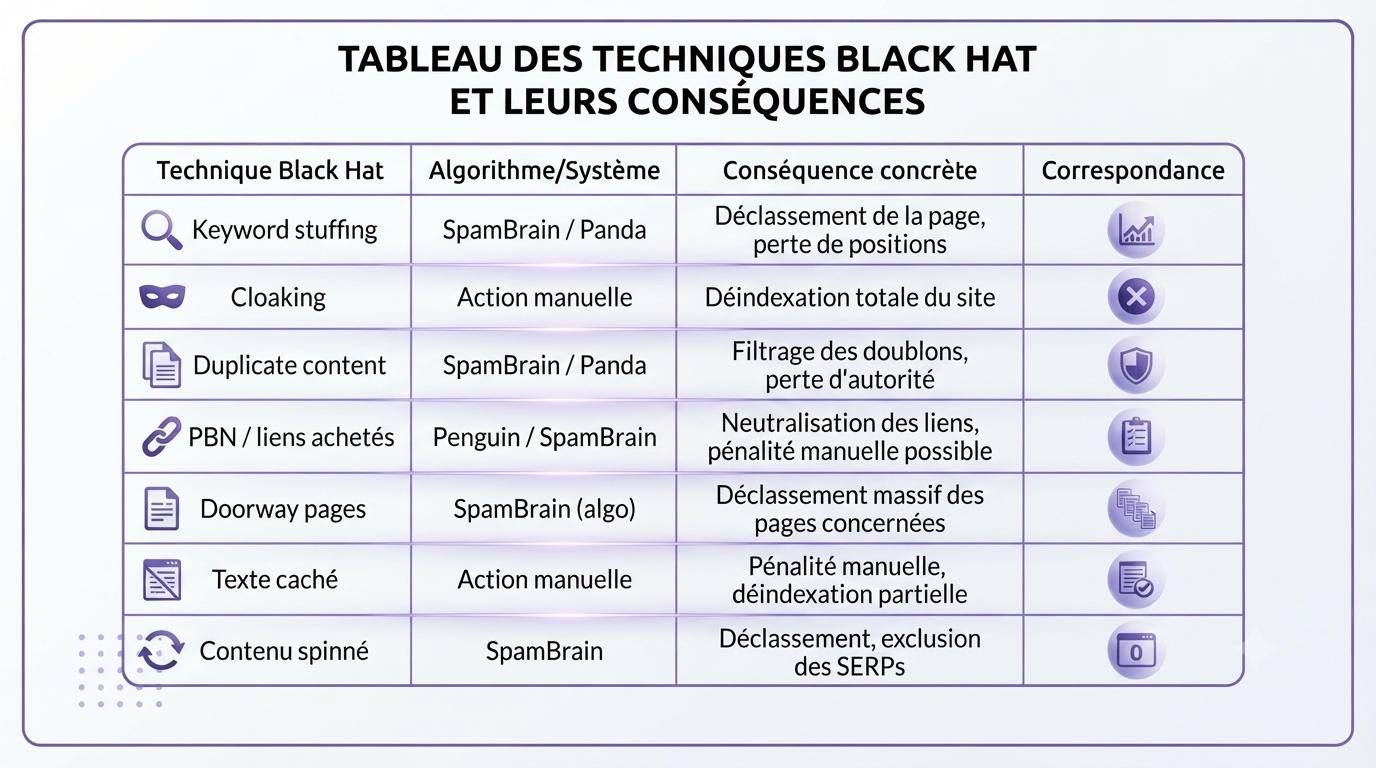
The Black Hat SEO includes techniques that seek to manipulate Google's algorithms to achieve quick results. While they may sometimes work in the short term, they expose websites to penalties that can range up to deindexing.
Here are the 10 most common black hat practices, how they work, and why they usually end up being penalized.
1. Keyword stuffing
Overusing a keyword on a page to force a higher ranking. A page that mentions «cheap running shoes» 47 times in 300 words is keyword stuffing.
Why it «works» in the short term: The old algorithms took keyword density into account. Why is this a punishment?: Panda, and later SpamBrain, immediately detect text that «doesn’t make sense» to a human. The page is demoted or deindexed.
2. Cloaking (different content for Google and the user)
The cloaking involves showing an optimized version to Googlebot and a different version—often of lower quality or off-topic—to actual visitors.
Why it «works» in the short term: Google indexes perfectly optimized content. Why is this a punishment?: This is one of the violations subject to the most severe penalties. A manual action can be taken within a few weeks, resulting in complete deindexing.
3. Duplicate content
Copying content from other sites—or duplicating your own pages on a large scale—to inflate the number of indexed pages.
Why it «works» in the short term: More pages = a better chance of ranking. Why is this a punishment?: Google filters out duplicates and keeps only one version. The others disappear from the SERPs. The site loses overall authority.
4. PBN – Private Blog Network
A PBN is a network of websites created solely to send links to a target site. You buy expired domains with authority, publish minimal content on them, and link to the money site.
Why it «works» in the short term: Inbound links remain a strong signal. Why is this a punishment?: SpamBrain analyzes hosting fingerprints, WHOIS data, and content patterns. In 2025–2026, PBNs are detected within a few weeks. The March 2026 spam update specifically targeted AI-generated PBNs.
5. Bulk-purchased links / link farms
Buying hundreds of links from directories, low-quality forums, or «link farms» to create the illusion of popularity.
Why it «works» in the short term: rapidly increasing number of backlinks. Why is this a punishment?: Penguin, which has been integrated in real time since 2016, neutralizes these links. Worse still: a toxic link profile can trigger a manual penalty on the entire domain.
6. Hidden text / hidden links
Place text in white on a white background, in size 0, or behind an image to insert keywords or links that are invisible to the user.
Why it «works» in the short term: Googlebot used to read the source code without «seeing» the visual rendering. Why is this a punishment?: Google has been indexing pages for years. Hidden text is detected automatically. The result: manual action is almost always taken.
7. Doorway pages
Create hundreds of nearly identical pages targeting each variation of a keyword or each city, without any truly distinct content.
Why it «works» in the short term: Maximum coverage of long trails. Why is this a punishment?: Google identifies them as «scaled» content with no added value. Since the August 2025 spam update, these pages have been algorithmically demoted—without even triggering a manual action.
8. Content scraping
Automatically scrape content from other websites to republish it as-is, or with minor automated modifications.
Why it «works» in the short term: rapid publication of large volumes. Why is this a punishment?: Google identifies the original source and demotes the copies. The scraping site loses all algorithmic credibility—and risks DMCA takedown notices.
9. False reviews and false click signals
Generate artificial clicks on one's own search results (via click farms or bots) to simulate a high CTR. Or post fake reviews to boost reputation signals.
Why it «works» in the short term: CTR and behavioral signals influence rankings. Why is this a punishment?: Google detects abnormal click patterns using data from Chrome and Search Console. Click farms have recognizable IP fingerprints. Penalties may be imposed immediately.
10. Content spinning (low-quality, auto-generated content)
Use tools to automatically rewrite existing articles—by replacing words with synonyms—to churn out «unique content» in bulk.
Why it «works» in the short term: A massive amount of content, at virtually no cost. Why is this a punishment?: SpamBrain has been specifically trained on these patterns since 2024. Spun content is detected as SEO spam and deprecated. The March 2026 update further strengthened this detection.
Google Penalties: What You Can Really Expect
All the techniques for Black Hat SEO are not penalized in the same way. Google primarily applies two types of penalties, depending on the severity of the practices detected and how they are identified. Understanding this difference helps you assess the actual consequences of a non-compliant SEO strategy.
Two Types of Penalties
Algorithmic penalty: Silent, automatic, with no notification in Search Console. You’ll only notice it when you see a sudden drop in traffic. You can’t request a reconsideration—you’ll need to fix the issue and then wait for the next update.
Manual penalty: Triggered by a Google reviewer. Visible in Search Console > Manual Actions. A reconsideration request can be submitted after the issue has been resolved.
How long does it take to recover?
The reality is harsh: 3 to 12 months for an algorithmic penalty, after all corrections have been made. For a manual penalty, allow 2 to 8 weeks after a request for reconsideration has been accepted—provided the cleanup work is deemed satisfactory.
Some websites never recover. This is especially true for those whose entire domain has been associated with massive spamming practices. Google may simply never trust them again.
Anonymized real-life cases
Fashion E-commerce Site (2024): +600 % in traffic over 4 months via PBN. Manual penalty in week 18. Organic traffic: zero. Recovery: 14 months, without returning to the initial level.
Finance Blog (2025): Keyword stuffing on 200 pages. August 2025 spam update. Loss of 85 % in traffic over 72 hours. No manual action—purely algorithmic. Still recovering.
Black Hat SEO and AI: A Double Whammy in 2026
This is a point that many agencies still don't mention. Black hat SEO no longer just destroys your Google visibility—it also excludes you from AI-generated results.
SpamBrain 2025–2026: The AI That No Longer Forgives
SpamBrain now analyzes hundreds of billions of pages continuously. The March 2026 spam update—rolled out in less than 20 hours—further strengthened the detection of AI-generated PBNs, bridge pages, and low-value bulk content.
Black Hat pages last, on average, 6 to 8 weeks in the SERPs before being demoted. Compared to 9 months in 2022. The window is closing.
GEO AI: ChatGPT, Gemini, and Perplexity Do Not List Penalized Sites
AI engines generate their responses from sources deemed reliable, authoritative, and properly indexed. A website penalized or deindexed by Google simply does not exist in their reference databases.
Direct consequence: In 2026, a black hat strategy will make you invisible on two fronts simultaneously—both traditional Google SERPs AND AI-generated answers. This is a double whammy that tracking tools often don’t yet measure.
The GEO (Generative Engine Optimization) – Optimization for AI-powered search engines – is based on exactly the same principles as white-hat SEO: authority, reliability, and original content. Black-hat SEO is structurally incompatible with this kind of visibility.
White Hat SEO vs. Black Hat SEO: The True ROI Calculation
The choice between Black Hat and White Hat SEO It’s not just a matter of speed, but of long-term profitability. While the former can offer immediate visibility, the latter builds sustainable growth that can withstand Google’s algorithm updates. This table compares the two approaches based on key performance metrics.
| Criterion | Black Hat SEO | White Hat SEO |
|---|---|---|
| Initial gains | Fast (1–3 months) | Progressive (6–12 months) |
| Sustainability | No score – penalty inevitable | High – compound returns |
| Risk | Very high (deindexing) | Low |
| AI Visibility | None after the penalty | Yes, if it is a constructed authority |
| Recovery Cost | Very high (audit + reconstruction) | None |
| ROI at 18 months | Negative in most cases | Positive and growing |
In the short term, the Black Hat SEO may seem appealing, but its true cost often becomes apparent after a penalty or a loss of visibility. Conversely, the White Hat SEO It requires more patience, but offers a long-term return on investment, greater credibility, and better chances of being visible both on Google and in AI responses.
Example with figures
Black Hat Scenario: An e-commerce site invests €3,000 in a PBN and purchased links. Result: +500 % in organic traffic in 3 months. Google penalty in month 4. Traffic: 0. Estimated cost of recovery: €8,000 to €15,000. Loss of revenue during the 12-month recovery period: variable, often catastrophic.
White Hat Scenario: With the same budget allocated to content, internal linking, and editorial link building. Result: +340 % in traffic over 12 months. Continued growth. No risk of penalties. Visibility on Google AND AI.
The True Cost of Black Hat
We often forget to account for:
- The Audit of Toxic Relationships (Ahrefs, Semrush): €500 to €2,000
- Cleaning the contents : several weeks of work
- Loss of revenue during the penalty period
- Rebuilding Domain Authority : At least 12 to 24 months
- The Psychological Cost : constant uncertainty, stressful waiting for updates
Black hat SEO isn't banned just because it's «wrong.». It is prohibited because it does not generate returns over the long term—and because it destroys real value.
What should you do if your website has been penalized?
A Google penalty isn't necessarily irreversible, provided you act quickly and methodically. The priority is to identify its cause, correct risky practices, and gradually rebuild Google's trust. Here are the five steps to follow to regain lasting visibility.
Step 1 – Identify the penalty
Open Google Search Console. Go to Security and Manual Actions > Manual Actions. If nothing shows up but your traffic has dropped sharply, it’s an algorithmic penalty. Compare this with the history of the Google Updates to identify the trigger.
Step 2 – Audit of Toxic Relationships
Use Ahrefs or Semrush to export your backlink profile. Identify low-authority domains, links from link farms, and PBNs. Compile them into a file .txt for the Google Disavow Tool (accessible via Search Console).
Step 3 – Cleaning the Content
Audit each flagged page. Delete or rewrite pages that contain keyword stuffing. Address duplicate content using canonical tags or 301 redirects. Remove doorway pages that offer no added value.
Step 4 – Request for Reconsideration (Manual Penalties Only)
Once the cleanup is complete, document each corrective action. Submit a Request for Reconsideration in Search Console. Be specific, factual, and provide evidence of the work you've done. Google usually responds within 2 to 8 weeks.
Step 5 – White Hat Reconstruction
This is the only sustainable approach. Original and useful content, editorial link building, a well-designed user experience, and strengthened E-E-A-T signals. Rebuilding takes time—but every action permanently strengthens the domain’s authority.
Has your website been penalized, or do you suspect black-hat practices? A comprehensive SEO audit helps identify risks before they result in penalties.
FAQ
Is Black Hat SEO illegal?
No, black hat SEO is not illegal in the legal sense of the term. It is a violation of Google’s Terms of Service, not of the law. However, certain associated practices—such as scraping copyrighted content or creating fake reviews—may have legal implications. The main consequence remains a Google penalty: lower rankings, deindexing, and a total loss of visibility.
How long before a Google penalty?
It depends on the technique and the scale. Aggressive cloaking can trigger a manual action within a few weeks. A PBN can last 2 to 6 months before being detected by SpamBrain. Since 2025–2026, these timeframes have shortened: Black Hat pages last an average of 6 to 8 weeks in the SERPs, compared to 9 months in 2022.
Is it possible to recover from a black hat penalty?
Yes, but it’s a long and uncertain process. For a manual penalty: make corrections + submit a reconsideration request; you’ll receive a response in 2 to 8 weeks. For an algorithmic penalty: make thorough corrections, then wait for the next Google update—which can take 3 to 12 months. Some heavily penalized sites never return to their original ranking levels. Recovery is never guaranteed.
Is Grey Hat SEO risky?
Yes, and increasingly so. Gray-hat SEO operates in a gray area that’s shrinking with every update. What was tolerated in 2022 may be penalized in 2026. Unlabeled sponsored links, semi-automated content, and link exchanges between niche sites are practices that SpamBrain monitors closely. The risk is moderate but real—and the line between this and black hat SEO is blurred.
How can I tell if my SEO agency is using black-hat techniques?
Several red flags: she promises results in less than 30 days; she doesn’t explain her link-building methods; your backlink profile suddenly explodes with unknown domains; she talks about «site networks» or «link boosts .» Check your backlink profile on Ahrefs or Semrush. Regularly review the Manual Actions section of your Search Console. A reputable agency documents every action and has nothing to hide.