
Key points:
- AI systems (ChatGPT, Gemini, Perplexity) are becoming product discovery engines. If your store doesn't appear there, you're losing customers before they even get to Google.
- GEO (Generative Engine Optimization) is the practice of optimizing your content so it appears in AI-generated responses—it complements SEO, not replaces it.
- AI systems cite what Google already considers to be the standard. Ranking high on Google is still the foundation. But that's no longer enough.
- 5 practical strategies: Enhanced product listings, «Best X 2026» pages, authoritative content, conversational search queries, and targeted backlinking.
Why AI Is a Game-Changer for E-Commerce

Purchasing behavior is changing right before our eyes.
In 2025, traffic referred by AI platforms to e-commerce sites surged by +4,700 % in one year in the United States. In Europe, the share of interactions related to AI tools tripled between April 2024 and June 2025. And the Google AI Overviews are now displayed on more than 50 % Google searches.
It's no longer a long-term trend. It's the present.
A shopper looking for «what is the best sunscreen for sensitive skin?» no longer necessarily types those words into Google. Instead, they ask them directly to ChatGPT, at Perplexity or at Gemini. These engines provide it with a synthesized response—including brand names, recommended products, and links to a few sources.
If your store isn't listed among these sources, it won't appear in this response.
The problem is structural: Visibility for an AI-powered online store doesn't happen by accident. It takes work. And most e-commerce businesses haven't done anything about it yet.
SEO vs. GEO: What's the Difference for an Online Store?
The GEO – Generative Engine Optimization – is a term formalized in 2023 by researchers at Princeton (Aggarwal et al., arXiv:2311.09735). The definition is simple: Optimize your content so that it can be discovered, understood, and cited by AI engines that synthesize responses from multiple sources.
It's not a revolution. It's an evolution of SEO.
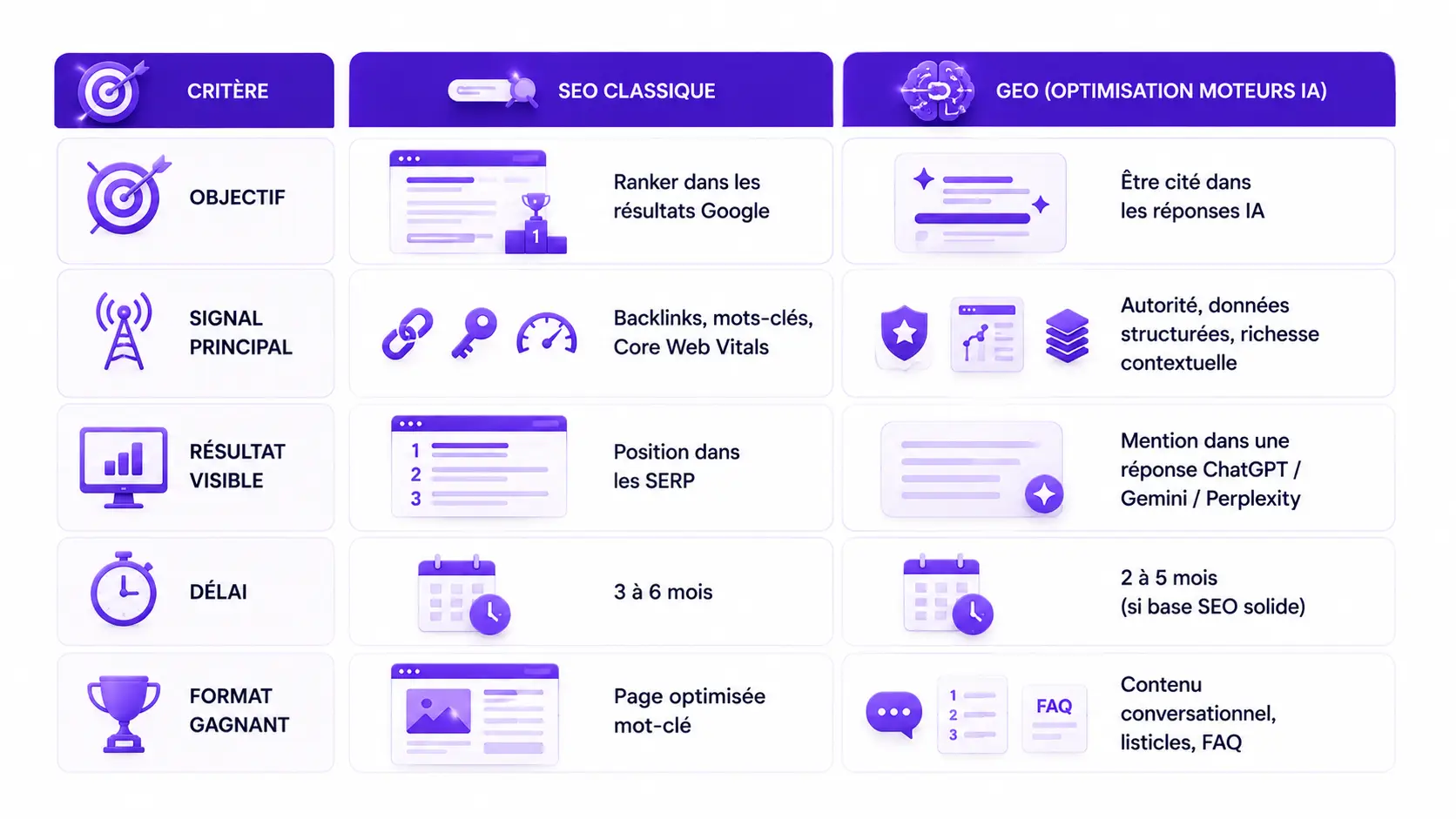
The golden rule: no GEO without SEO. AI systems rely on Google’s index to find their sources. If you don’t rank, you’re not in the database they consult. E-commerce AI SEO involves doing both at the same time.
How AI Systems Choose Which E-Commerce Sites to Feature
Here's what actually happens when a user asks Perplexity or ChatGPT a question (with web search enabled).
AI Launches Real-Time Search – on Bing for ChatGPT, and on its own index for Perplexity – then it synthesizes the results into a coherent response. It doesn't scan the entire web. It scans the pages that already rank well.
What this means for you: Ranking first on Google is still the best way to be cited by AI. But that's not the only criterion.
The three filters that AI systems then apply:
1. Domain authority. A website with strong backlinks, mentions in reputable media outlets, and a presence on multiple platforms (Reddit, Trustpilot, industry publications) will be preferred over an isolated website, even if it ranks highly.
2. The freshness of the content. Perplexity E-commerce places a high value on recent content. A product page updated in January 2026 will be ranked higher than a page that hasn't been updated since 2022. Google AI Overviews for e-commerce work the same way.
3. The wealth of structured data. AI systems read code just as much as they read text. A schema.org Product Complete information—including price, availability, reviews, and brand—provides AI engines with a direct and reliable overview of your product.
The 5 GEO Strategies for Your E-Commerce Store
Optimization for AI search engines does not rely on a single technique. For an online store to be regularly cited by ChatGPT, Gemini, Perplexity, or Google’s AI Overviews, several factors must align: content quality, structured data, domain authority, and user experience.
Here are the 5 GEO levers that currently have the greatest impact on improving your e-commerce site’s visibility in AI-generated results.
1. Optimize Your Product Listings for AI
A typical e-commerce product listing looks like this: «Red, size M, 100 % cotton.» For a human who already knows what they’re looking for, that’s enough. But for an AI that has to decide whether your product is worth recommending, it’s not enough.
What AI systems expect from a product listing:
- A detailed, context-rich description that answers shoppers« real questions: »Is this product suitable for sensitive skin?«, »What size should I choose if I wear a 38/40?«, »Can it be used in the winter?”
- Paragraphs of 130 to 170 words formulated as direct answers—this is the format that Google AI Overviews for e-commerce prioritizes.
- A schema.org Product Complete in JSON-LD:
name,description,brand,offers(price + availability),aggregateRating,review. This is the language that AI systems can read directly.
An AI product page is a product page that answers questions before they’re even asked.
2. Create a page titled «Best [Product] of 2026»
This is the format most frequently cited by AIs. Without exception.
When ChatGPT responds to the question «What is the best sports smartwatch in 2026?», it looks for a page that has already done this kind of summary work. A well-structured listicle, with clear criteria, a comparison table, and an FAQ section.
Required format for citation:
- Exact Title As the year comes to a close: «Best Sports Smartwatch of 2026: Our Picks»
- Numbered list products with a brief description of each one
- Comparison Chart (price, key features, who it's for)
- FAQ at the bottom of the page, with questions that buyers ask ChatGPT
This format is exactly what AI engines are looking for: a source that has already synthesized the information. You become the reference they cite.
3. Create authoritative content in your niche
AI systems do not cite generic product descriptions. They cite authoritative websites.
What this means in practice:
- Blog posts with raw data : product tests conducted by your team, side-by-side comparisons with an explanation of the methodology, and case studies of real clients.
- A identified author with a bio, a photo, and a LinkedIn profile—the E-E-A-T (Experience, Expertise, Authority, Trustworthiness) signal that Google and AI use to assess a source’s credibility.
- Some primary sources cited in your articles (studies, official reports, statistical data). A page that cites its sources is more credible than one that makes claims without evidence.
An e-commerce site that publishes «We tested 12 SPF 50 sunscreens for 3 months: here are our results» is infinitely more likely to be cited by Perplexity E-commerce than an e-commerce site that publishes «Discover our sunscreen line.»
4. Optimize for conversational queries
AI systems are given long, natural questions—not short keywords.
«Best CBD» → nobody types that into ChatGPT. However: «Which CBD should I choose to help me sleep when I’m stressed and have never tried it before?»—that’s exactly the kind of question users ask.
How to adapt your content:
- Identify the 10 questions your customers ask most often (customer service, reviews, social media).
- Create a Structured FAQ on every product and category page – with the markup
FAQ Pagein schema.org. - Write category introductions that directly answer the question «How do I choose [your product]?» in 2 to 3 paragraphs.
It is this conversational content that AI systems draw on to formulate their responses. To be quoted by ChatGPT, you first need to write the way ChatGPT responds.
5. Boost Your Authority with Backlinking
AI systems cite websites that Google considers to be authoritative sources. And Google considers a website to be an authoritative source when other reputable websites mention it.
The Backlink Strategy for GEO E-commerce:
- Media and Trade Press : An article in an industry magazine that mentions your brand is worth 10 times as much as a directory backlink.
- Blogs and Comparison Sites : appearing in the «top 10» of your category on third-party sites—that’s exactly the format that AI systems cite.
- Reddit and forums : Perplexity cites Reddit as one of its sources (~47 %). Authentic discussions about your brand in relevant communities are a direct GEO driver.
The goal isn't to accumulate links. It's to be mentioned in the places where AI systems look for their sources.
Case Study: CBD Store +380 % in Organic Traffic

A French CBD e-commerce site—which we’ll call «BotanicaShop» to protect its privacy—contacted us in early 2025 with a common problem: it wasn’t showing up on Google and didn’t appear in AI search results.
Initial situation:
- Product listings averaging 80 words, without schema.org
- No blog posts in the last 18 months
- Domain with a DR (Domain Rating) of 12
- No results found in ChatGPT or Perplexity for queries related to "CBD France"
Actions taken over a 4-month period:
- Complete redesign of product pages : detailed descriptions of 300+ words, an integrated FAQ on each product page, and a complete schema.org Product schema with reviews and availability
- Creation of 3 authoritative articles : «Best CBD for Sleep in 2025: Our Comparison of 8 Tested Products,» «CBD and Stress: What the Science Says in 2025,» «Complete Guide to Choosing CBD for Beginners»
- Backlink Campaign : 14 backlinks obtained from health and wellness media outlets and specialized CBD blogs
Results at 4 months:
- +380 % in organic traffic
- Frequent mentions in ChatGPT for «best CBD in France» and «CBD for sleep reviews»
- Appears in Google AI Overviews for 6 target queries
- DR increased from 12 to 31
AI-powered e-commerce SEO isn't magic. It's SEO done right, with a geo-targeting layer on top.
The 90-Day GEO Action Plan for Your E-Commerce Business
GEO doesn't produce results overnight. Like a traditional SEO strategy, it relies on a solid foundation, regular content creation, and a gradual build-up of the site's authority.
Here is a roadmap on 90 days to improve your e-commerce site's visibility on Google, ChatGPT, Gemini, and Perplexity.
DAY 0–30: Foundations
- SEO + GEO Audit : Identify pages that rank but aren't cited by AI, product pages without schema.org, and conversational queries that aren't covered
- Optimizing Priority Product Listings : the 20 % products that generate 80 % of revenue – rich descriptions, integrated FAQs, complete schema.org Product markup
- Implementation of Structured Data :
Product,FAQ Page,BreadcrumbList,Organization– validation via the Google Rich Results Test
DAY 30–60: Authority Content
- 1 article titled «Best X 2026» in your main category: structured listicle, comparison table, FAQ, identified author
- 2 blog posts with original content: product reviews, comparisons, buying guides
- Optimizing Category Pages : conversational introduction, structured FAQ, date update
DAY 60–90: Authority and Follow-up
- Targeted backlinking campaign : 5 to 8 placements in media outlets and blogs in your industry
- Tracking AI Citations : Manually test your target queries on ChatGPT, Perplexity, and Gemini every week
- Adjustments : Enhance the pages that appear in the AI Overviews; expand the FAQs on pages that haven't been mentioned yet
FAQ
What is AI SEO for e-commerce?
AI e-commerce SEO—also known as GEO (Generative Engine Optimization)—refers to the set of optimizations that enable an online store to be mentioned in the responses generated by AI engines such as ChatGPT, Gemini, Perplexity, and Google AI Overviews. It builds on traditional SEO (Google ranking) and incorporates specific signals: structured data, conversational content, domain authority, and content freshness.
Can my e-commerce site appear in ChatGPT?
Yes. ChatGPT with web search enabled queries the Bing index in real time. If your site ranks for relevant search queries and your content is structured to answer questions, you may be cited. The most commonly cited formats include «best X» listicles, buying guides, comparison charts, and FAQs.
How long does it take to be cited by AI?
With an existing SEO foundation and targeted GEO initiatives, the first mentions typically appear between 2 and 4 months. Without an SEO foundation, expect it to take 4 to 6 months. Results depend on the level of competition in your niche and how quickly the action plan is implemented.
Does GEO replace SEO for an online store?
No. GEO does not replace SEO—it complements it. AI systems rely on the Google index to find their sources. Without a strong Google ranking, your content won’t come into the AI engines’ field of view. E-commerce AI SEO is about combining both.
What budget should you set aside for AI-powered SEO for an e-commerce site?
It all depends on the starting point. An e-commerce site with a solid SEO foundation can launch a GEO plan with €3,000 to €6,000 over 3 months (audit, product page optimization, 3 authority content pieces, initial backlinking). An e-commerce site starting from scratch—with no Google rankings and no content—will need to set aside a larger budget over a 6-month period. The investment pays off quickly: visitors referred by AI convert 31 % better than the organic average.