
Key points:
- Programmatic SEO, ...means creating hundreds (or thousands) of SEO-optimized pages using a single template combined with a structured database.
- When should you use it? As soon as you have a repeatable keyword pattern: city × service, product × category, integration × tool.
- Expected results: Pages indexed within a few weeks, long-tail traffic that builds up over 3 to 6 months, and a competitive advantage that’s hard to catch up to.
- The 2026 Perspective: At Rank-Up, we build programmatic pages that rank on Google and that are cited by AI engines—ChatGPT, Gemini, and Perplexity. It’s the SEO + GEO AI combo.
What is programmatic SEO?
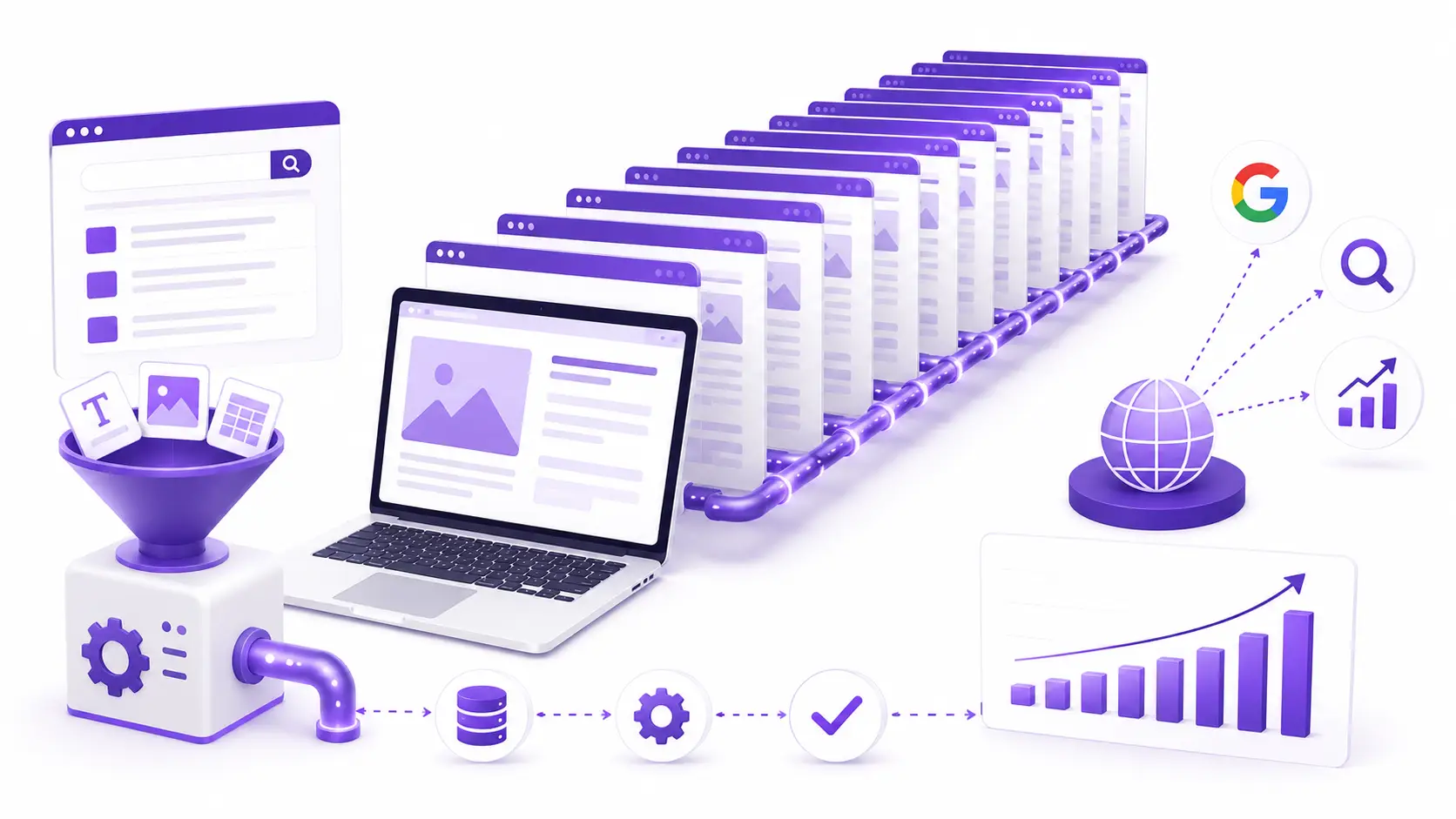
The Programmatic SEO (or programmatic SEO (in English) is based on a simple idea: instead of creating each page by hand, you design a template and populate it with data from a database. The result? Dozens, hundreds, or even thousands of Automated SEO pages generated in record time.
The basic formula is:
Template × Data = Pages
Examples That Speak for Themselves
The biggest players on the web have built their SEO dominance on this approach:
- TripAdvisor : a «Restaurants in » template × millions of cities → approximately 71 million indexed pages, more than 400 million unique visitors per month.
- Airbnb : «Rent [type] in » → thousands of local pages that dominate search results for “accommodation” in each destination.
- Zapier : «Connect [Tool A] with [Tool B]» → between 50,000 and 500,000 pages of integration, more than 350,000 targeted keywords.
- Leboncoin : category pages organized by department and ad type → virtually guaranteed visibility in local search results.
- Booking.com : «Hotels in » × every city in the world → millions of pages that capture every booking intent.
It's not magic. It's a method.
Traditional SEO vs. Programmatic SEO
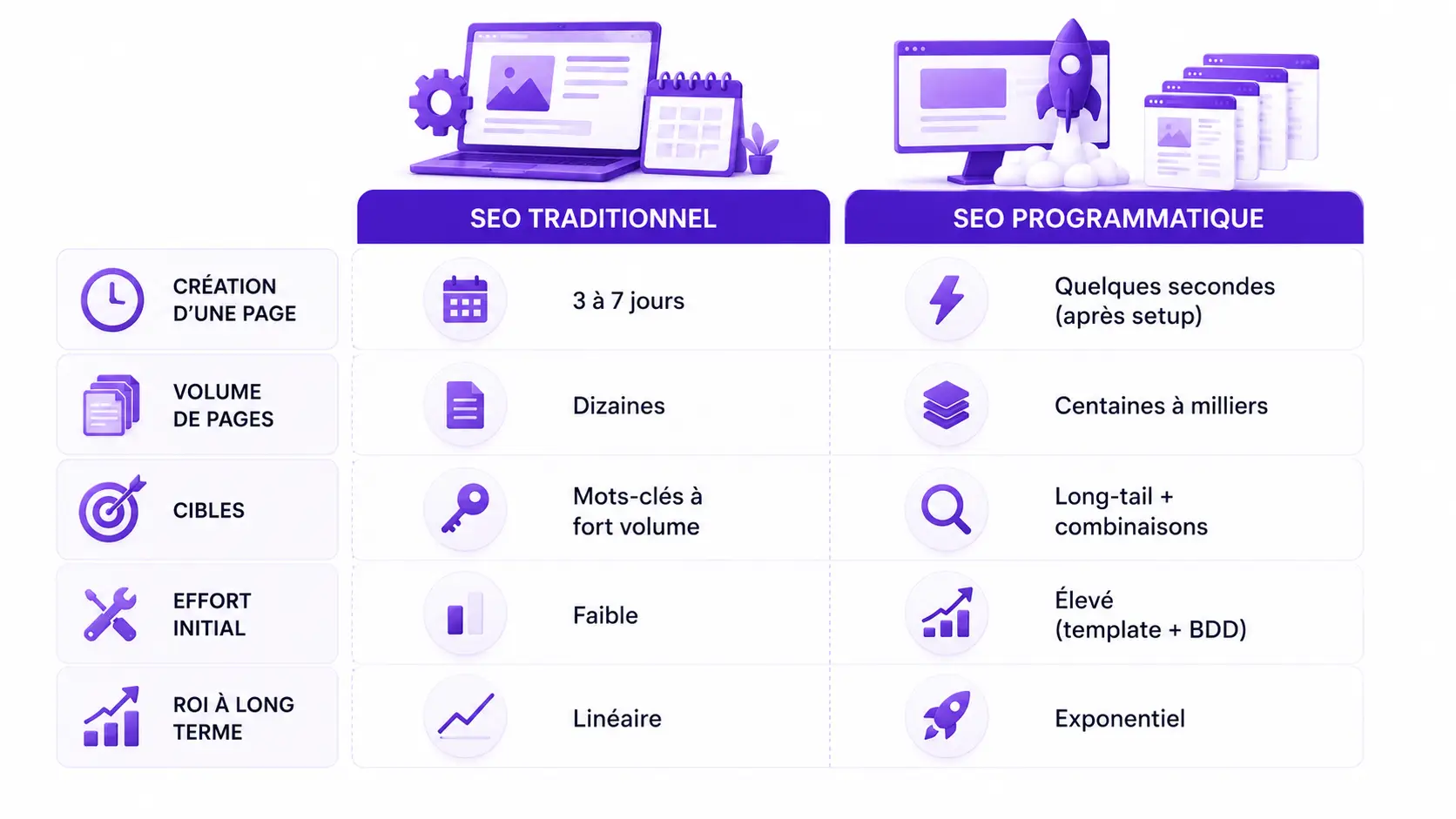
Why Programmatic SEO Is a Game-Changer for Small and Medium-Sized Businesses
We often hear: «Programmatic SEO is for large corporations.» That's not true.
The reality: A local small business or e-commerce site can deploy 200 to 500 targeted pages in just a few weeks with the right tools—and capture traffic that its competitors haven’t even anticipated yet.
The long tail: where the real traffic is
70 % of Google searches are long-tail queries, with fewer than 100 searches per month each. Individually, they seem insignificant. But when combined across 500 pages, they represent a considerable volume—and often a very strong intent to purchase.
A concrete example: «SEO agency Bordeaux» might get 200 searches per month. But «SEO agency Bordeaux e-commerce,» «SEO agency Bordeaux lawyer,» and «SEO agency Bordeaux SME» each generate 20 to 50 searches. Multiply that by 30 combinations like these, and you’ve got qualified traffic that no one else has targeted.
A competitive gap that is difficult to bridge
Once 500 pages have been indexed and ranked, a competitor starting out with traditional SEO needs to several months to produce the same amount of content. This is a structural advantage, not just a time-saver.
The Most Effective Use Cases for SMEs
- Local Offices : one page per target city («SEO agency,« «SEO consultant«)
- E-commerce : one page per product × category × location combination
- SaaS : one page per integration or use case («invoicing software for [industry]»)
- Legal / Real Estate : one page per practice area × city («divorce lawyer,« «real estate agency [neighborhood]»)
→ Request your free programmatic SEO audit – We'll analyze your page potential within 48 hours.
The 3 Types of Programmatic Landing Pages
All the programmatic landing pages are not all the same. There are three main families, each with different levels of complexity and power.
Geography Pages
This is the most common type. You take a service and break it down by city or region.
Examples: SEO agency in Paris, SEO agency in Lyon, SEO agency in Bordeaux, SEO consultant in Nantes…
The principle is simple, but it must be executed carefully: each page must contain actual local data (customer references in the city, the local economic context, etc.) so that it is not considered duplicate content.
Pages by Category or Vertical
We take a geographic area (or a generic target) and break it down by industry or product type.
Examples: SEO for Lawyers, SEO for Real Estate, SEO for E-commerce, SEO for Restaurants…
These pages are designed to address a very specific need: a lawyer looking for an SEO agency doesn't want to read a generic page. He wants to see that you understand his specific challenges.
Combined Pages
It's a combination of the two previous approaches. And that's where the power comes into play exponential.
Examples: SEO agency for lawyers in Paris, real estate SEO agency in Lyon, E-commerce SEO Consultant in Bordeaux…
With 10 cities × 10 sectors, you get 100 pages. With 20 × 20, you get 400. The growth is geometric, and each page targets an ultra-specific search intent with competition that’s often virtually nonexistent.
How to Build a Programmatic SEO Strategy in 5 Steps

Here's the method we use at Rank-Up. There are no shortcuts: every step is essential.
Step 1 – Identify keyword patterns
Before creating anything, you need to identify repeatable patterns. You're looking for groups of keywords that share the same format, with one variable that changes.
How to:
- Export keywords from Ahrefs or Semrush and group them by pattern
- Search for «X + [variable]» queries in Google Suggest
- Analyze your competitors' pages that rank for dozens of similar variations
Positive signal: If you find 20 or more keywords with the same pattern and attractive combined search volumes, you have a use case for scalable SEO.
Step 2 – Create the page template
The template is the common framework for all your pages. It defines what remains fixed and what changes.
What remains constant: H1/H2/H3 structure, generic text blocks, CTAs, basic FAQs, schema markup.
What's changing: the main variable (city, sector, product), associated contextual data, local examples, and metadata (title, meta description, URL).
Golden Rule: The template must generate pages that provide real value to the user, not just a variable substitution. An «SEO agency» page where only the city name changes = risk of a Google penalty.
Step 3 – Build the database
It's the driving force behind the entire strategy. The database contains all the variables and contextual data for each page.
Common tools:
- Google Sheets / Excel : A Simple Way to Get Started
- Airtable : for more structured projects with relationships between tables
- Concept : useful for editorial teams
- CMS Database (WordPress, Webflow): directly integrated into the publishing process
For each entry (each future page), we provide: the main variable, local/contextual data, specific examples, and custom metadata.
Step 4 – Generate and publish the pages
Several technical approaches depending on your tech stack:
- WordPress + ACF (Advanced Custom Fields) : the most widely used for small and medium-sized businesses, flexible, and without a heavy development load
- Webflow CMS : ideal for visual projects featuring collections of content
- Custom Development : Python or Node.js for generating HTML files or powering a CMS API
- No-code tools : Whalesync, Flatfile, or Make (formerly Integromat) to sync Airtable → CMS
Point to watch out for: Publish in batches and monitor indexing in Google Search Console. Publishing 1,000 pages all at once without internal linking = risk of wasting your crawl budget.
Step 5 – Quality Control and Avoiding Duplicate Content
This is the step that most people skip. And it’s the one that makes the difference between a project that takes off and one that falls short.
Rules to follow:
- Each page must have a unique meta description (dynamically generated from the database)
- Use canonical tags properly configured
- Include at least a single content block per page (local data, specific example, concrete example)
- Set up a hub-and-spoke internal network : a pillar page that links to all the programmatic pages
- Regularly audit your site using Screaming Frog or Sitebulb to detect duplicate content
Programmatic SEO + GEO AI: The 2026 Combo
That's when everything changes. By 2026, optimizing solely for Google will no longer be enough.
ChatGPT, Gemini, Perplexity directly answer your potential customers’ questions. If your website isn’t mentioned in those answers, you’re invisible to a growing portion of your audience.
What is GEO (Generative Engine Optimization)?
The GEO (Generative Engine Optimization) is the practice of optimizing content to be cited by AI engines, not just to rank on Google. The metrics are changing: we’re talking about share of voice in AI responses, citation rates, and sentiment in LLM outputs.
How Programmatic Pages Can Be Structured for AI
Search engines favor pages that:
- Clearly answer a specific question (question → direct answer format)
- Use structured data (schema.org: LocalBusiness, FAQPage, Service)
- Cite specific named entities (city name, industry, type of service)
- Have subject-matter authority (coherent content cluster, logical internal links)
A concrete example
A law firm with 50 program pages per city. Each page is structured to respond to «best divorce lawyer» in ChatGPT:
- H1: «Divorce Attorney in [City] – Law Firm X»
- FAQ section with the exact question and a 2-3 sentence answer
- Diagram
LegalService+FAQ Page+LocalBusiness - Local data: address, coverage area, examples of cases handled
Result: The page ranks on Google and The firm is mentioned when a user asks ChatGPT, «Which lawyer should I choose for a divorce in Lyon?»
Our Approach at Rank-Up
We don't build programmatic pages «for Google.» We build them for The Comprehensive Research Ecosystem of 2026 : Google, Bing, ChatGPT, Gemini, Perplexity. Each page is designed to rank and to be cited. That’s the difference between traditional, scalable SEO and a sustainable acquisition strategy.
→Request your free programmatic SEO audit – We assess your GEO AI potential at the same time.
Mistakes You Must Avoid at All Costs
Poorly executed programmatic SEO can do more harm than good. Here are the most common pitfalls.
Thin content (content that is too sparse). Simply changing the name of a city in a generic text is exactly what Google has been penalizing since the 2023 Helpful Content Update. Each page must provide real and specific value.
No single value per page. An «SEO agency in Paris» page that doesn’t specifically mention Paris—no local references, no market context, no specific data—will not convince either Google or a human visitor.
Internal links ignored. Hundreds of pages without coherent internal links waste your crawl budget and prevent your site’s authority from growing. Implement a hub-and-spoke structure from the start.
Unsupervised indexing. Publishing 500 pages ≠ having 500 pages indexed. Some pages may remain in the «Discovered – currently not indexed» status for weeks. Track indexing in Google Search Console page by page (or in batches via sitemaps).
Duplicate content not managed. Without proper canonical tags and unique meta descriptions, Google may treat your pages as duplicate content and fail to index them. This is a technical error, not an editorial one—but it can be costly.
Real-world examples of successful programmatic SEO
Programmatic SEO is already being used by some of the web’s largest platforms to generate millions of pages targeting specific search intent. These examples demonstrate how a strategy based on page templates and structured data can drive organic visibility on a massive scale.
TripAdvisor: The Ultimate Guide
TripAdvisor has built its SEO empire on a single principle: «restaurants/hotels/activities in » × every city in the world. The result: approximately 71 million indexed pages, 5.6 million targeted keywords, and a #1 position on the first page for virtually every local tourism-related search query. One template, user data, total dominance.
Airbnb: The Geographic Long Tail on a Large Scale
Airbnb automatically generates «rent [property type] in » pages for every destination where accommodations are available. These pages dominate local accommodation searches in hundreds of countries—without a single one being written by hand.
Rank-Up: SEO Agency Pages by City
We apply the same logic to our own pages: a dedicated page for each target city—Paris, Lyon, Nantes, Bordeaux, Troyes, Aix-en-Provence… Each page targets «SEO agency» with real local data, client testimonials from the region, and a GEO AI structure to appear in conversational search engine results.
E-commerce: 200 products × 10 categories = 2,000 SEO pages
A Shopify site with 200 product listings and 10 categories can generate 2,000 programmatic pages by targeting combinations such as «men’s waterproof hiking boots,» «women’s lightweight trail hiking shoes,» and so on… Each page targets a specific intent and has a higher conversion rate than generic pages.
When is programmatic SEO right for you?
You don't need millions of pages to get started. But there are a few requirements you need to meet.
Programmatic SEO is right for you if:
- Do you have a repeatable keyword pattern (city, category, product type, sector)
- You can create a one value per page (local data, context-specific content)
- You have 50+ keyword targets identified
- You are in a competitive market where manual SEO is too slow
- Do you want a sustainable structural advantage rather than one-time visibility
Programmatic SEO is not suitable if:
- You have fewer than 20 relevant targets
- You don't have any structured data to work with
- Your content is purely editorial (blog, news, opinion)
- You cannot guarantee a unique value for each generated page
If you check at least 3 boxes, you probably have real potential. The next step is the audit.
FAQ – Programmatic SEO
How many pages can be created using programmatic SEO?
There is no technical limit. Zapier has over 500,000 pages, and TripAdvisor has over 71 million. For an SME, a realistic project starts with between 50 and 500 pages. What matters isn’t the raw volume, but the quality and relevance of each page generated. It’s better to have 100 well-structured pages than 1,000 empty ones.
Could programmatic SEO hurt my website's ranking?
Yes, if done poorly. Google penalizes automatically generated content that offers no added value (thin content, duplicate content, page spam). The rule is simple: each page must address a genuine search intent with unique and useful content. The Google Search Essentials are clear on this point: it's the value to the user that matters most, not the volume.
What tools should you use for programmatic SEO?
For keyword searches: Ahrefs, Semrush, Google Search Console. For the database: Airtable, Google Sheets, Concept. For page generation: WordPress + ACF, Webflow CMS, Python scripts, or no-code tools such as Make (formerly Integromat). For the technical audit: Screaming Frog, Sitebulb. For GEO IA monitoring: Profound, Evertune.
How long does it take to see results with programmatic SEO?
The first pages are typically indexed within 2 to 6 weeks. The first significant rankings appear between 2 and 4 months. Cumulative traffic really starts to make an impact after 4 to 6 months, once a critical mass of pages has been indexed and the internal linking structure has consolidated the site’s topical authority.
Does programmatic SEO work for local small and medium-sized businesses?
Absolutely. It’s actually one of the most effective use cases. A local small business can target «service + city» for 20 to 50 cities in its catchment area, with pages that incorporate real local data. The production cost is well below that of 50 manually written pages, and the SEO impact is often greater thanks to structural consistency and internal linking.