Key points:
- 40 % for passengers already use an AI tool to plan their trips (Statista, Nov. 2024). More than half use ChatGPT at least occasionally.
- The Google AI Overviews appear in about 60 % of travel-related searches in 2025. Traditional organic traffic is declining for informational searches.
- The GEO (Generative Engine Optimization) involves creating pages that AI systems cite in their responses—it complements, rather than contradicts, traditional SEO.
- Tourism stakeholders who combine Technical SEO + «Best of» Content + Structured Data are the ones recommended by Google AND ChatGPT.
The tourism industry is one of the most competitive sectors on Google. And since 2025, it has also been the favorite playground for ChatGPT, Gemini, and Perplexity. Just being well-ranked isn't enough anymore: you also need to be cited by AI systems.
This guide is intended for hotels, travel agencies, tourist offices, campgrounds, and vacation rental providers who want to attract qualified organic traffic—and remain visible in a rapidly changing search landscape.
→ Request your free GEO SEO Audit
Tourism: An Industry Transformed by AI
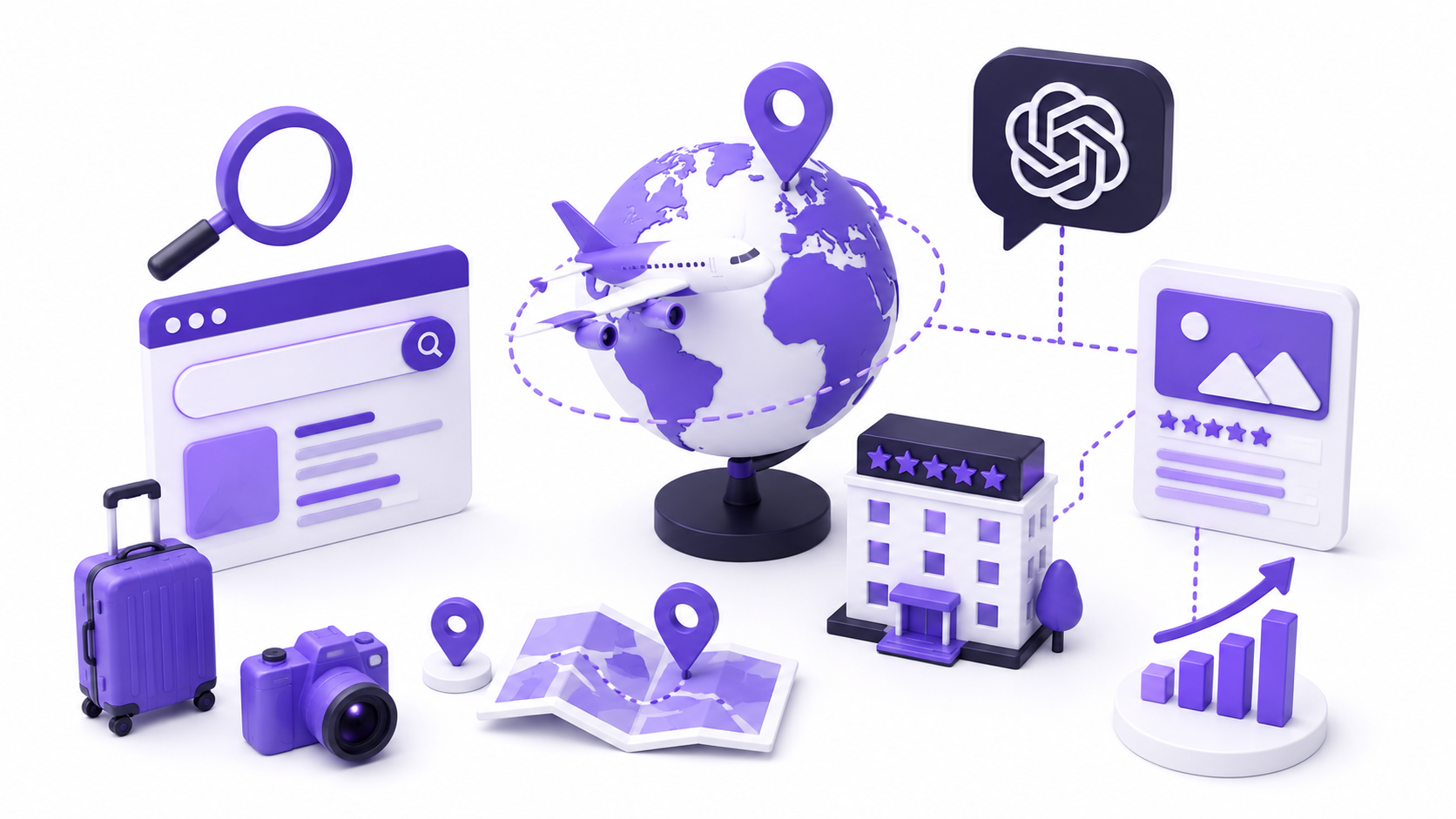
Travelers in 2026 no longer type «cheap hotel in Paris» into Google and click through ten links. Instead, they ask ChatGPT directly: «Recommend a boutique hotel in the Marais, under 200 € per night, for a weekend getaway for two in July.»
And the AI responds with two or three specific names.
Numbers That Change Everything
- +1 200 % : This is the increase in traffic to travel websites from AI sources over the past 12 months (Adobe Analytics, 2025).
- 84 % Travelers who used AI to plan their trips believe it improved their experience (McKinsey, March 2026).
- Visitors referred by an AI have a bounce rate 45 % lower than average—they are closer to conversion.
- 60 % Travel-related searches on Google now trigger an AI Overview, compared to 10–15 % a year ago.
The Two-Speed Problem
On the one hand, Google remains indispensable for transactional searches («book a hotel in Lyon,» «campground availability in Brittany»). On the other hand, ChatGPT and Gemini are increasingly capturing the inspiration and comparison phase—the stage where decisions are made.
A tourism business that optimizes solely for Google is missing half the conversation.
That's the crux of the problem—and the reason why the AI-Driven SEO for the Travel Industry became a priority in 2026.
Tourism SEO: The Unchanging Fundamentals
Before we talk about GEO, we need to make sure we have a solid foundation. AI systems reference pages that Google ranks highly—not the other way around.
Match the search intent
In tourism, two types of intentions coexist:
- Informational : «Things to do in Bordeaux with the family,» «Best time to visit Corsica.» → Editorial content, guides, lists.
- Transactional : «book a hotel room in downtown Bordeaux,» «5-star campground in Arcachon.» → Landing pages with clear CTAs, availability, and prices.
Each page should serve a specific purpose. A page that tries to do both ends up failing at both.
Title Tag, H1, and Internal Linking
The Search Engine Optimization for Tourism is based on simple fundamentals that are often poorly applied in the industry:
- The title tag must contain the main keyword + the location (e.g., «Boutique Hotel in Paris's Marais District – Book Direct»).
- The internal linking The relationship between destination pages, accommodation pages, and activity pages is critical. Google (and AI systems) understand your offerings better when the pages complement each other.
- The internal link anchors must be descriptive, not generic («click here» is useless).
Local SEO: Prioritize Google Business Profile
Whether it's a hotel, a campground, or a water activity, the Local SEO is often the quickest way to get results. A well-filled-out Google Business Profile (GBP) appears in the Local Pack—those three results with a map that show up before the organic search results.
Must be optimized:
- Main category and specific subcategories.
- Recent, high-quality photos (according to Google, businesses with 100 or more photos receive 520 % more calls).
- Responses to reviews—all of them, both positive and negative.
- Specific features (swimming pool, parking, pets allowed, wheelchair access, etc.).
Core Web Vitals and mobile-first
70 % of travel searches are conducted on mobile devices. A slow website means lost traffic before users even see your offer. LCP under 2.5 seconds, CLS close to zero, INP under 200 ms—these are the benchmarks to aim for to stay competitive in Hotel SEO such as SEO for travel agencies.
GEO Tourism: How ChatGPT and Gemini Choose Their Recommendations
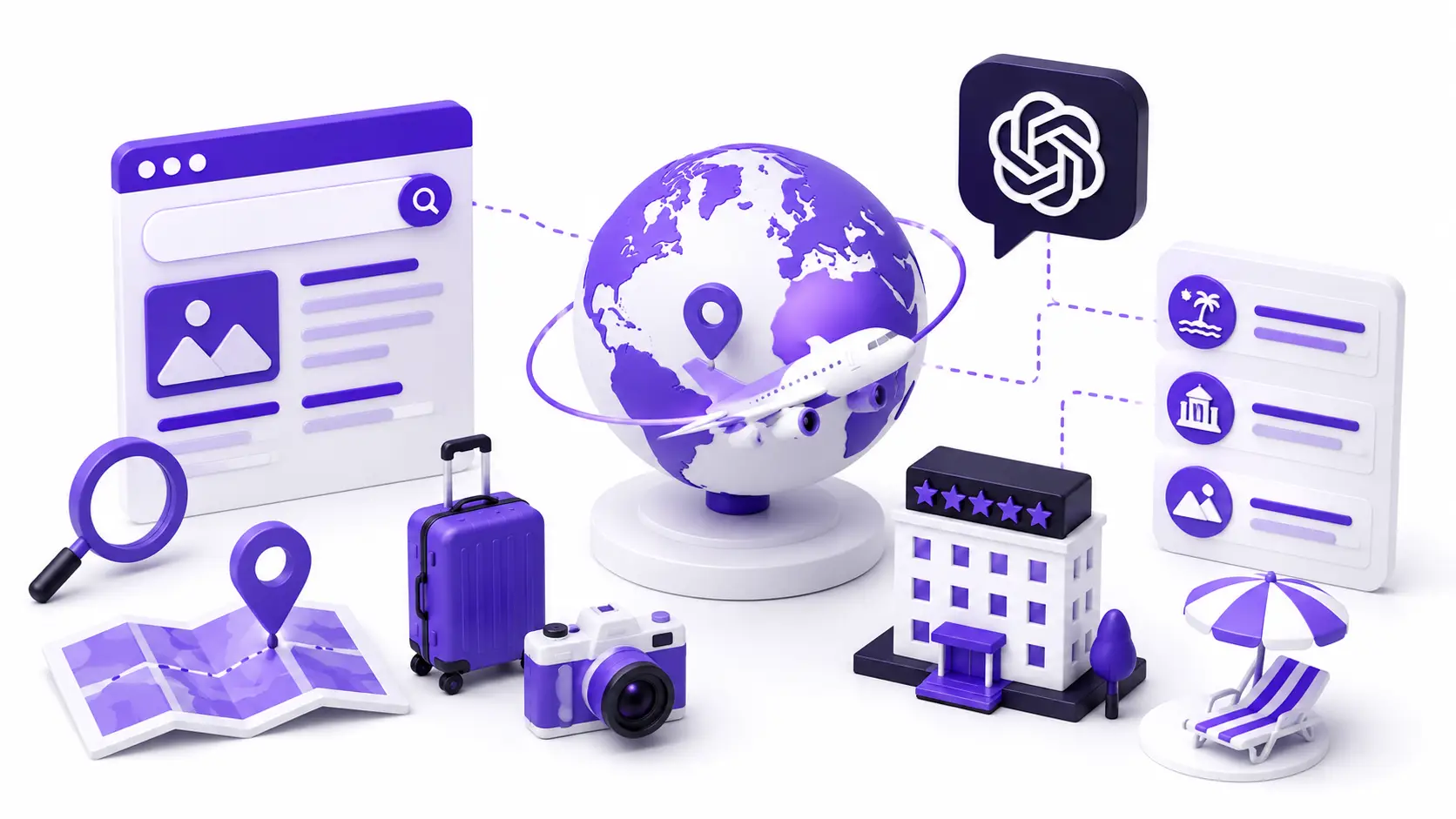
What exactly is GEO? Create pages that AI engines use as a source when a traveler asks them a question.
The Basic Mechanism
ChatGPT, Gemini, and Perplexity don’t «search» like Google. But when they need fresh data or specific recommendations, they perform web searches—and they cite the pages that rank first for the queries they type in themselves.
Ranking #1 on Google for queries asked by AI = being cited in their answers.
What challenges does AI pose for the tourism industry?
Here are some real-world examples of queries that ChatGPT or Gemini generate in the background:
- «Best Boutique Hotel in Paris 2026»
- «Top Adventure Travel Agencies in France 2026»
- «Best Campground in Brittany 2026»
- «Best Water Activities in the Mediterranean, Summer 2026»
- «Bordeaux Tourist Office: Things to Do in 2026»
These queries have a common structure: superlative + niche + location + year. These are exactly the «best of» pages you need to create.
Traditional SEO vs. Tourism SEO: The Key Differences
The GEO (Generative Engine Optimization) It does not replace traditional SEO; rather, it complements it. While the fundamentals remain the same, certain criteria have become essential for maximizing your chances of being ranked by AI-powered search engines.
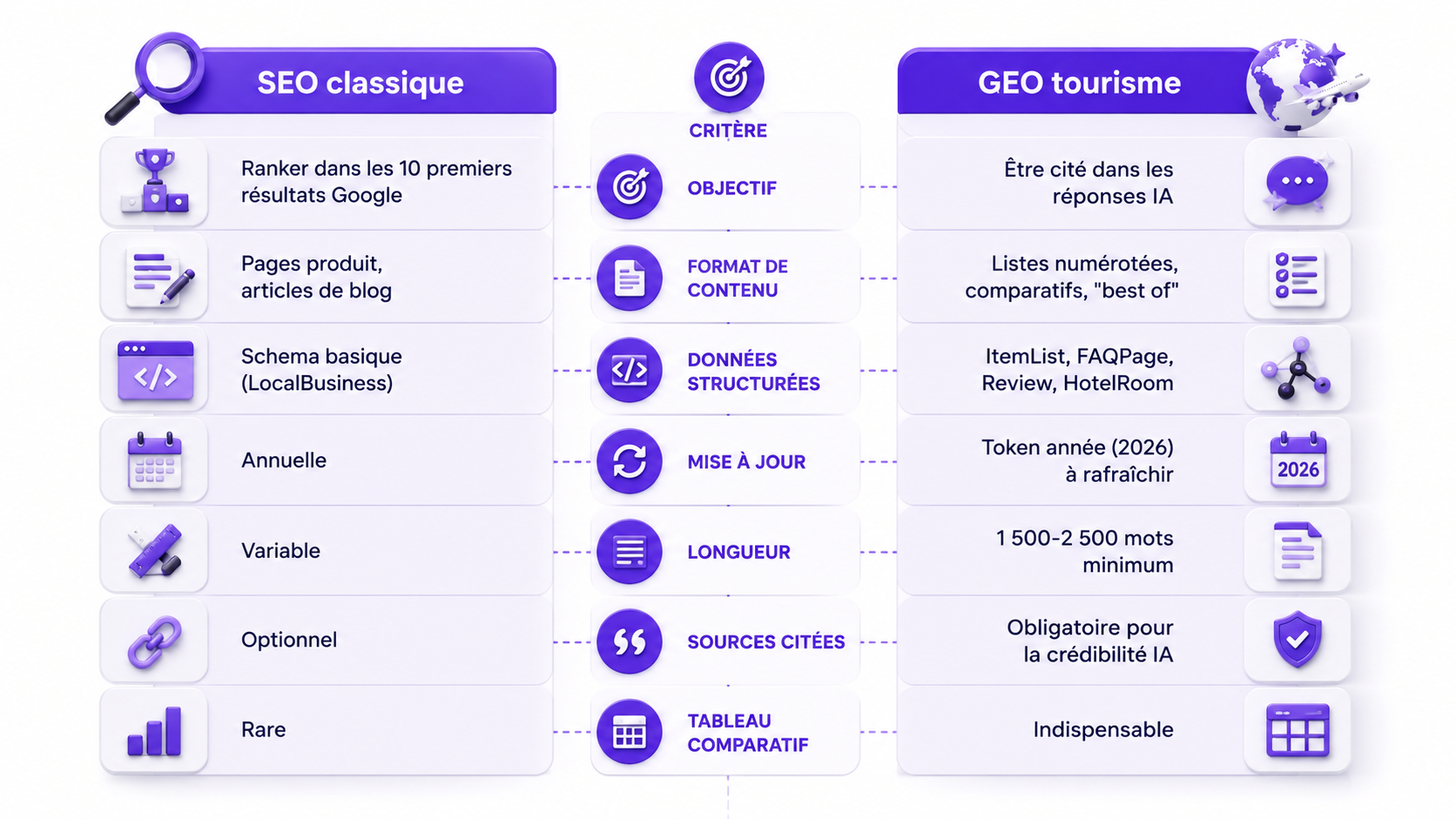
To succeed in SEO, simply ranking well on Google is no longer enough: producing structured, reliable content that AI can easily process is also essential. Adapting your strategy to these new criteria is becoming a real competitive advantage.
The GEO canonical page template for tourism
A page optimized for AI Visibility in Tourism follows this structure:
- H1 with superlative + niche + location + year → «The 10 Best Boutique Hotels in Paris in 2026»
- Introduction answering the question directly (AI systems love direct answers in the first paragraph).
- Numbered list with one H3 per school/program.
- Comparison Chart (price, rating, highlight).
- FAQ with the real questions travelers ask.
- ItemList Schema + FAQ Page in JSON-LD.
It is this combination that triggers quotes in ChatGPT and sidebars in Google's AI Overviews.
Types of Tourism Stakeholders and Their SEO+GEO Priorities
Every player in the tourism industry faces specific SEO and GEO challenges depending on their line of business. Tailoring your strategy to your specific business allows you to better meet travelers’ expectations and increase your chances of being visible both on Google and in AI-generated responses.
Hotels and Accommodations
The Hotel SEO begins with three non-negotiable priorities:
- Keywords : «hotel [neighborhood],» «hotel with [amenities],» «budget / luxury / family-friendly hotel.».
- GBP : Comprehensive, up-to-date photos, responses to reviews within 48 hours.
- Review Management : Google, Booking, TripAdvisor. The average rating and how recent the reviews are directly influence AI recommendations.
- Diagram :
LodgingBusiness+HotelRoomincluding prices, amenities, and availability. This is what ChatGPT uses to choose your establishment over a competitor.
For GEO: Create a page «Why Choose [Hotel Name] in [City] in 2026» with comparisons, FAQs, and structured data.
Travel Agencies and Tour Operators
The SEO for Travel Agencies depends on the landing pages—and that’s often where the work is most lacking.
- Every top destination deserves its own page: «10-Day Morocco Tour», «Family Safari in Kenya», «Summer Road Trip in Iceland».
- The itinerary content (day by day) is very well indexed AND frequently cited by AI systems.
- The GEO page to create first: «Best [Niche] Travel Agency in France 2026» – That’s exactly what ChatGPT looks for when a traveler asks it for a travel agency recommendation.
Tourist Offices and Destinations
The tourist office stands to gain the most from the GEO Tourism – and the least well-positioned to benefit from it today.
- Create «Things to Do in» pages structured as numbered lists using Schema
Tourist Attraction. - Become the reference entity about your destination: Wikipedia, Wikidata, mentions in the local press, partnerships with travel media outlets.
- AI systems cite tourist offices that have a clear subject matter authority within their territory.
Campgrounds, vacation rentals, water activities
These stakeholders face a specific challenge: seasonality. SEO professionals should anticipate search spikes 3 to 6 months in advance.
- Make the «Summer 2026» pages live starting in January.
- Optimize for the Local Pack with GBP + schema
CampgroundorSports, Activities, and Rentals. - Import the schema
Offerwith availability dates to appear in Google's rich results. - For GEO: one page «Best Campground [Region] 2026» "With a comparison table" is one of the formats most frequently mentioned by ChatGPT in this segment.
The 90-Day Rank-Up Method for Tourism
We don't promise miracles. We promise a structured approach that has been tested on real tourism stakeholders.
J0–J30: Technical Foundations
- Comprehensive SEO Audit : crawling, Core Web Vitals, indexing, keyword cannibalization.
- GBP Optimization : photos, categories, attributes, Q&A.
- Correcting Critical Errors : redirects, duplicate tags, orphaned pages.
- Mapping Intentions : Which pages exist, which are missing, and which overlap.
Days 30–60: Content Strategy
- Creation or redesign of Destination Pages priorities.
- Drafting of the GEO's «Best Of» pages (numbered lists, comparison tables, "Year 2026" token).
- Deployment of FAQ on each key page.
- Implementation of structured data (ItemList, FAQPage, LodgingBusiness, HotelRoom…).
J60-J90: GEO Citations and Authority
- Outreach to travel listicles (blogs, specialized media) to get mentions and backlinks.
- Submission to the reference directories in the sector (Atout France, regional tourism offices, OTA platforms).
- Monitoring of AI quotes : We're checking to see if ChatGPT, Gemini, and Perplexity are starting to cite the pages we've created.
- Initial Assessment and Adjustments.
Typical result observed : At a 4-star campground in Brittany, a 68% increase in organic traffic within 90 days after creating 4 «best of» GEO pages, optimizing Google Business Profile, and implementing the Campground schema. First ChatGPT mentions as early as week 8.
Free SEO + GEO Audit – Get Started on Your 90-Day Plan
FAQ
How long does it take to rank for «hotel»?
For a competitive local search query like «hotel in downtown Lyon,» expect 3 to 6 months to reach the top 5 in organic search results, provided you start with a solid technical foundation. The Local Pack (Google Maps) can be unlocked more quickly—sometimes in 4 to 8 weeks—with targeted Google Business Profile (GBP) optimization and a campaign to generate recent reviews.
Does ChatGPT really recommend specific hotels?
Yes, and with increasing accuracy. Since the integration of Booking and Expedia connectors into ChatGPT (2024–2025), the AI can check availability in real time and recommend 2 to 3 specific properties, along with an explanation for the selection. To be included in this selection, your hotel must have clear, structured data on its website, recent reviews across multiple platforms, and ideally be mentioned in «best of» articles that AI systems use as sources.
Does my tourism office need an SEO blog?
Not necessarily a «blog» in the traditional sense. What he needs is structured content pages answering visitors« real questions: »What to do in [location] in winter,« »The 10 must-see attractions in [region],« »A weekend in [destination] with kids.” These pages are well-structured with an outline Tourist Attraction and FAQs are exactly what Google includes in its AI Overview and what ChatGPT cites in its responses.
What is the difference between local SEO and GEO for a hotel?
The Local SEO aims to appear in Google's Local Pack (the three results with a map) for location-based searches. It relies on GBP, reviews, and NAP (Name, Address, Phone) consistency. The GEO aims to be cited in responses from ChatGPT, Gemini, or Google AI Overviews. It relies on structured «best of» pages, rich schema data, and topic authority. The two are complementary—a hotel that’s well-optimized for local SEO is also better positioned for GEO.
What should the SEO budget be for an independent travel agency?
For an independent agency with 5 to 20 destinations, a budget of 800 to 2,000 €/month covers the initial audit, the creation of 2 to 4 pages of content per month, and technical support. The first significant organic results typically appear between the 3rd and 6th months. ROI is measured in qualified traffic and quote requests—not in generic clicks.