Key points:
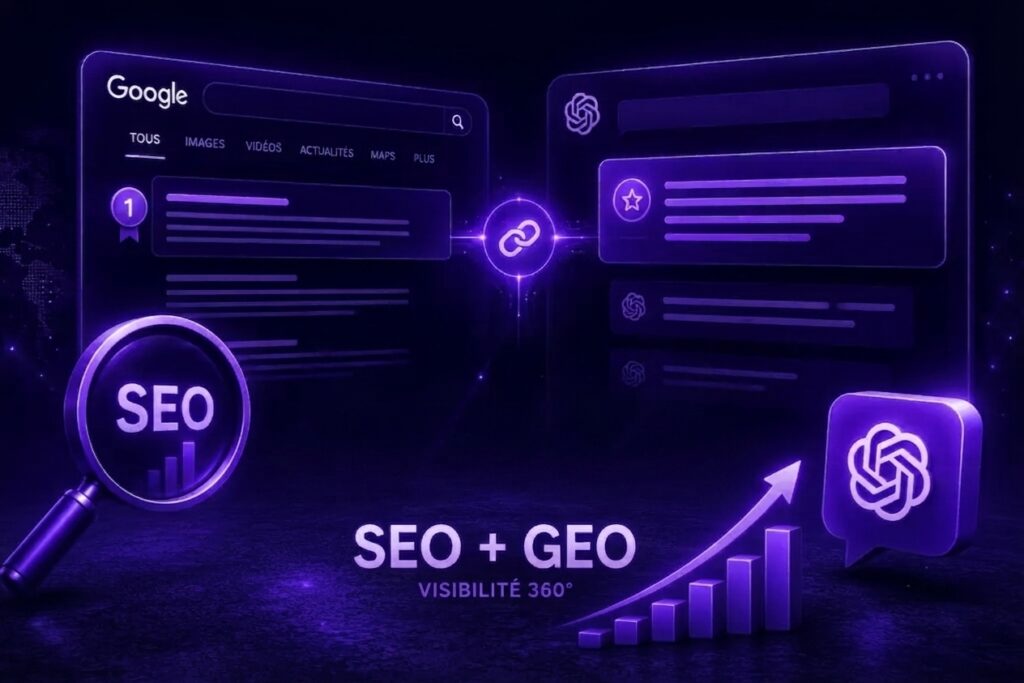
- GEO (Generative Engine Optimization) is the practice of optimizing your content so that it is cited in responses from ChatGPT, Gemini, Perplexity, and Google AI Overviews.
- In 2026, 37 % of consumers start their search with an AI chatbot rather than on Google—your traditional visibility is no longer enough.
- SEO and GEO are not mutually exclusive: Without good SEO, GEO doesn't work. The two reinforce each other.
- Rank-Up is the The only GEO + SEO agency! to manage both simultaneously using a structured 90-day methodology and reporting on organic revenue.
What exactly is GEO? A simple definition
The GEO – Generative Engine Optimization – This refers to the set of practices that increase the likelihood that your content will be selected, cited, and presented as a reliable source by a generative AI engine.
To put it simply: when someone asks ChatGPT, «Who is the best business lawyer in Lyon?», GEO determines whether your firm appears in the answer—or that of your competitor across the street.
It's not magic. It's a method.
GEO vs. SEO: Two Sides of the Same Coin
SEO ranks your pages in Google's search results. GEO makes you appear directly in the generated response by AI, without the user having to click on anything.
| Criteria | Traditional SEO | GEO |
|---|---|---|
| Objective | Rank in the top 3 on Google | Being mentioned in the AI response |
| Key Signal | Backlinks + keywords | Authority + Structure + Citations |
| Result Format | Clickable blue link | Mention in a summary response |
| Measuring Tools | Google Search Console, rankings | AI Share of Voice, Citation Frequency |
| Does it depend on SEO? | – | Yes, very much so |
Both approaches share the same foundations: high-quality content, domain authority, and structured data. That’s why you can’t do one without the other.
AEO, GEO, SGE: A Jargon-Free Glossary

The industry loves acronyms. Here's what they really mean:
- GEO (Generative Engine Optimization) : Optimization for generative AI engines (ChatGPT, Gemini, Perplexity, Claude).
- AEO (Answer Engine Optimization) : a variant of GEO focused on «response drivers»—the concept is the same, but this term is sometimes preferred in a B2B context.
- SGE (Search Generative Experience) : the former name of Google AI Overviews, the AI-powered answer block displayed at the top of Google search results.
- AI Overviews : the current name for SGE at Google—that AI-generated summary that appears before the organic search results.
AI Search Engine Optimization is the French umbrella term that covers all of this. In this article, it is used interchangeably with GEO.
Why 2026 Will Be a Game-Changer for Your Online Visibility
Search habits are changing rapidly. Internet users no longer just look at a list of Google results; they are increasingly relying on AI-generated answers. This transformation is profoundly changing the rules of online visibility and creating new opportunities for businesses that adapt to it now.
The Numbers That Hurt
Let's not beat around the bush.
878 million monthly users on ChatGPT in January 2026. 750 million on Gemini. And Google AI Overviews covers 2 billion people per month through the built-in search features.
According to Gartner analyses reported by several industry publications, the volume of traditional searches could drop by 25 % by the end of 2026, in favor of AI chatbots and virtual agents.
In France, 44 % of the working-age population already use ChatGPT or a similar tool for their research (France Num, 2025). France ranks among the top five countries worldwide in AI adoption.
It's not just a trend anymore. It's the new playground.
User behavior has changed
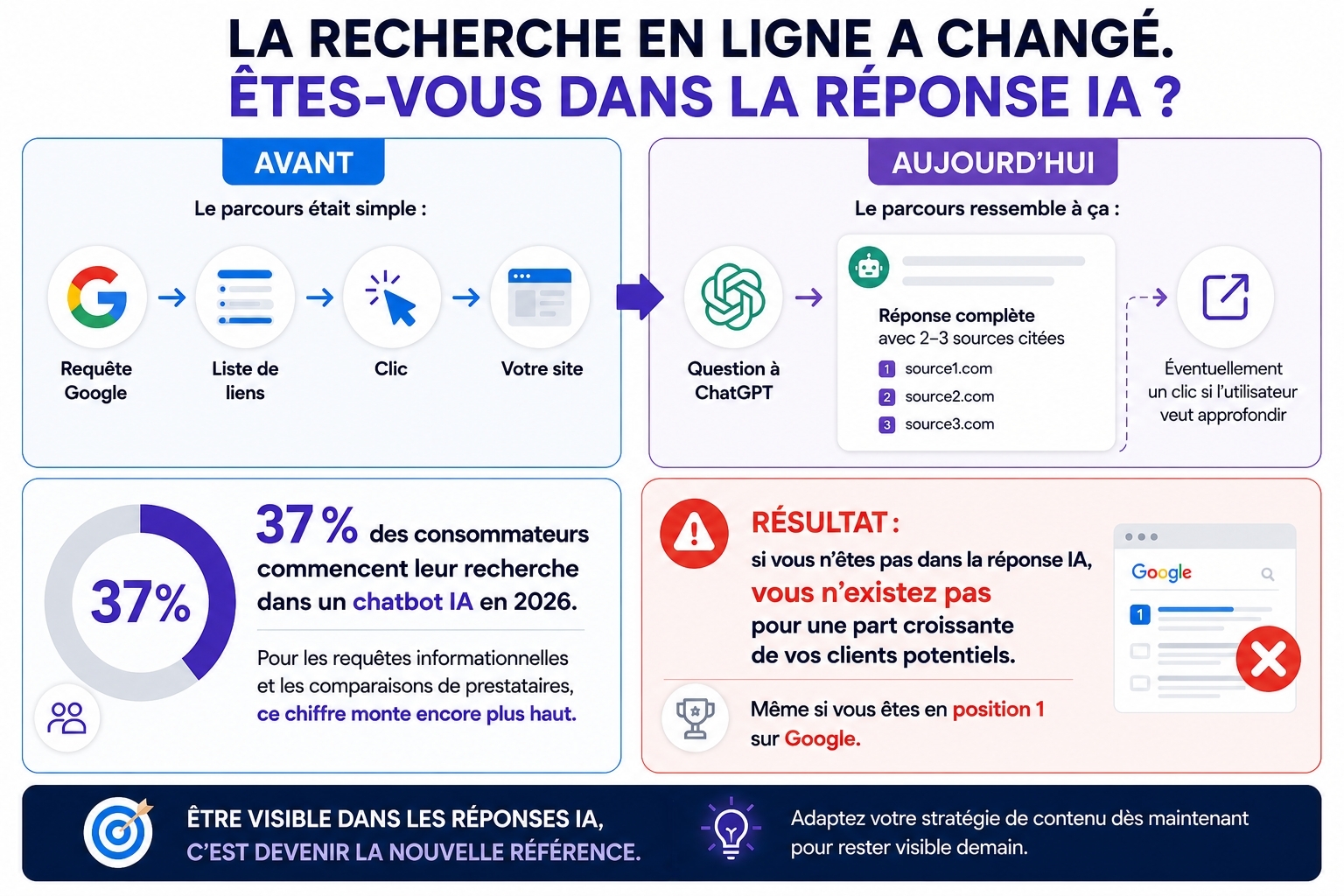
What This Means in Practical Terms for Your Business
For a law firm: a prospect who searches for «labor law attorney Paris» on ChatGPT and doesn’t find you in the results is a lead that will go to a competitor.
For a CBD e-commerce business: Google Ads are restricted, as are social media platforms. The ChatGPT visibility and the Gemini Visibility become your only high-potential organic acquisition channels.
For a real estate agency: being recommended by ChatGPT as a «reliable agency in Lyon’s 6th arrondissement» is worth ten times as much as an unread blog post.
GEO is not a luxury. It is a competitive necessity.
→ Request your free GEO + SEO audit
How Does the GEO Work? An Explanation of the Mechanism

AI-powered answer engines do not select their sources at random. To understand how to improve your visibility in their answers, you need to distinguish between the two mechanisms they use to find and generate information.
Mode 1: The Fixed Memory of AI
Large language models (GPT-4o, Gemini, Claude) were trained on billions of web pages up to a specific date—their «cutoff date».
What they absorbed during this training process constitutes their memory. If your website had low visibility, few backlinks, and poor structure prior to that date, you do not exist in their memory.
This strategy takes time to implement. It requires building a lasting online presence, backlinks from third-party sites, and strong domain authority. That’s exactly what good SEO does—and that’s why GEO SEO are inseparable.
Mode 2: Real-time Web Search (The Actionable Playground)
The good news: ChatGPT (with navigation enabled), Perplexity, Google AI Overviews, and Gemini perform real-time web searches to respond to numerous requests.
In practice, they type a query into Google or Bing, retrieve the first few pages, analyze them, and summarize an answer.
This mode is available immediately. If you rank in the top 3 on Google for a search query, there’s a high probability that you’ll be cited in the corresponding AI-generated answer.
It's the fastest way to make a difference—and the one your competitors are underutilizing the most.
The golden rule: no GEO without SEO
We emphasize this because it is fundamental: AI-driven search engine optimization relies on SEO as its foundation.
A study presented at the KDD 2024 conference (Aggarwal et al., based on 10,000 queries) confirms this: pages that rank highly in SEO are cited exponentially more often by AI systems. GEO techniques applied to a poorly ranked website yield only marginal gains.
Conversely, good SEO without GEO means you’re missing out on a growing share of traffic. That’s why the only approach that works in 2026 is to use both together.
The 5 GEO Strategies for Appearing in AI Responses
GEO is based on several best practices that enable AI models to better understand, select, and cite your content.
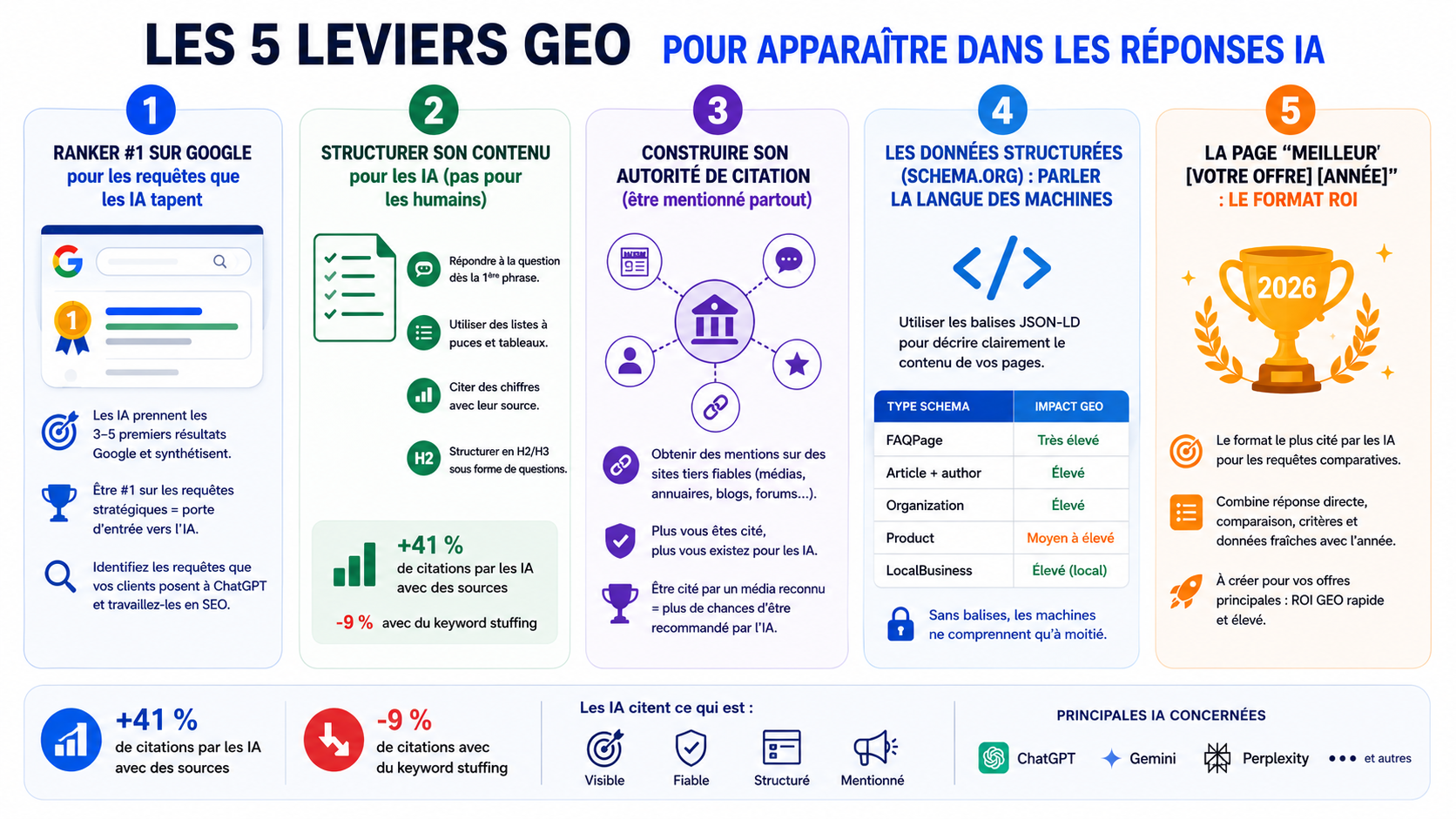
By using these strategies, you increase your chances of appearing in the responses generated by ChatGPT, Gemini, Perplexity, and other AI-powered search engines.
1. Rank ##1 on Google for search queries entered by AI systems
AI engines in real-time search mode behave like very demanding users: they take the first 3–5 Google results and summarize them.
Ranking #1 for strategic search queries in your industry is the main gateway to AI visibility.
Identify the queries your customers ask ChatGPT. Optimize these keywords using traditional SEO. Local SEO will naturally follow.
2. Structure Your Content for AI (Not for Humans)
AI systems don't read the way we do. They look for clear answers, direct statements, and cited data.
What works:
- Answer the question in the very first sentence in the paragraph (not after the first 3 lines of the introduction).
- Use bulleted lists and comparison charts—AI loves them.
- Cite figures along with their sources : «+41 % additional citations» with the study reference, not just «+41 %.».
- Organize into H2/H3 headings that are questions : «How does the GEO work?» rather than «The operation of the GEO.».
The KDD 2024 study shows that adding citations and sourced statistics increases the frequency with which AI systems cite +41 %. Keyword stuffing, on the other hand, reduces it by -9 %.
3. Build your citation authority (get mentioned everywhere)
AI systems trust entities that exist within their knowledge base. The more you’re mentioned on third-party sites—media outlets, industry directories, expert blogs, professional forums—the more you exist for them.
That's what's called the citation strategy : Get mentions of your brand, your executives, and your areas of expertise in sources that AI systems consider reliable.
A lawyer mentioned in an article in *Le Monde du Droit* is infinitely more likely to be recommended by ChatGPT than a lawyer who is virtually unknown outside of their own website.
4. Structured Data (Schema.org): Speaking the Language of Machines
The Schema.org structured data are JSON-LD markup elements that are invisible to users but readable by AI and search engines.
They explicitly describe what your page is about: an article, an FAQ, an organization, a product, or a person.
The GEO's priority types:
| Schema Type | Usage | GEO Impact |
|---|---|---|
FAQ Page |
Frequently Asked Questions at the bottom of the page | Very high |
Article + author |
Editorial content with identified authors | High |
Organization |
Home Page, Brand Identity | High |
Product |
E-commerce Product Pages | Medium to high |
LocalBusiness |
Professionals, Businesses | High (local) |
Without these tags, you're talking to machines in a language they only half understand.
5. The «Best [Your Offer] [Year]» page: the go-to format
This is the format that AI systems most often use for comparative queries.
«Best Business Lawyer in Paris, 2026.» «Best Real Estate Agency in Lyon's 6th Arrondissement, 2026.» «Best 1000mg CBD Oil, 2026.»
These pages combine everything AI loves: a direct answer to a specific question, a structured format, comparison criteria, and up-to-date data for the current year.
Creating these pages for your main offers is one of the fastest returns on investment in GEO that we've seen.
SEO + GEO at Rank-Up: Our 90-Day Method
We don't sell GEO in isolation. We don't sell SEO without GEO. We manage both simultaneously—because that's the only way to achieve measurable results in revenue.
Here's how it works in practice.
DAY 0: AI + SEO Visibility Audit
We start with a comprehensive assessment.
SEO : technical audit, ranking analysis, identification of keyword opportunities with high commercial potential.
GEO Section : We test 30 to 50 strategic queries on ChatGPT, Gemini, Perplexity, and Google AI Overviews. We measure your «AI share of voice»—how often you’re mentioned, in what context, and compared to which competitors.
By the end of Day 0, you know exactly where you stand. No guesswork.
DAY 30: SEO Basics + First GEO Pages
The first month is all about laying the groundwork.
We fix critical technical SEO issues. We optimize existing pages with high potential. And we create the first GEO pages: «best [offer] [year]» formats, structured FAQ pages, and content that answers the exact queries your prospects ask AI systems.
We are also implementing Schema.org structured data throughout the site.
DAY 60: AI citations + editorial outreach
In the second month, we build authority.
Editorial Outreach : We place mentions of your brand and areas of expertise on industry-specific media outlets and blogs that AI systems consider to be reliable sources.
AI Quotes : We work to enhance your visibility in the directories, databases, and platforms that LLMs consult during their training and real-time searches.
It's the most time-consuming—and most distinctive—strategy.
DAY 90+: Measurable Results in Organic Revenue
We're not talking about «rankings» or «traffic.» We're talking about organic revenue.
At the 90-day mark, we measure: the number of leads generated through organic search, the conversion rate, and revenue attributable to SEO and GEO combined.
We also measure your AI share of voice: out of your 50 strategic search terms, how many now mention you? On which platforms? In what context?
The results are concrete, quantifiable, and directly tied to your business.
→ Request your free GEO + SEO audit
Real-Life Examples: What Our Clients Have Achieved
The benefits of GEO are measured by concrete results. Here are a few examples of strategies implemented and the results achieved by companies that have boosted their visibility in search engines and AI-generated responses.
Law Firm: From Zero to Being Cited by ChatGPT in 60 Days
A law firm specializing in business law in Paris. Initially, it didn't appear at all in AI-generated responses. No structured pages, no Schema data, and content that was too generic.
In 60 days: creation of 8 GEO pages targeted at the exact queries submitted to ChatGPT, full Schema implementation, and 4 editorial placements in leading legal media outlets.
Result : Cited in ChatGPT and Perplexity responses to 6 target queries. +18 organic inbound leads in Month 3. The firm had never generated leads through digital channels before.
CBD E-commerce: +380% traffic + recommended by Gemini
Highly regulated industry: Google Ads not allowed, Facebook Ads restricted. SEO + GEO was the only scalable acquisition channel.
We worked on several fronts simultaneously: overhauling the SEO architecture, creating structured comparative content, and building citation authority in wellness and natural health media.
90-Day Results : +380 % in organic traffic. Recommended by Gemini for searches for «best CBD oil [strength].» Organic revenue increased 4.2-fold over the period.
Real Estate Agency: +12 leads/month through a combination of SEO and GEO
An independent real estate agency competing directly with national chains that have marketing budgets on a completely different scale.
Strategy: Dominate highly specific local search queries («real estate agency [neighborhood]«) in SEO, and create the corresponding GEO pages to appear in AI-generated responses for those same queries.
Result : An average of 12 qualified leads per month over the last 3 months. The cost of organic lead acquisition is one-sixth that of leads from paid real estate portals.
GEO for Your Industry: Key Points to Know
The principles of GEO remain the same, but their implementation varies depending on your line of business. Each sector has its own constraints, opportunities, and credibility criteria. Tailoring your strategy to your specific field improves your chances of being selected and cited by generative AI.
Regulated sectors (CBD, finance, healthcare): GEO as an alternative to ads
CBD, dietary supplements, finance, health: paid advertising is restricted, expensive, or prohibited. SEO + GEO therefore becomes the main driver of customer acquisition.
The advantage: Generative AI doesn’t (yet) have the same restrictions as advertising agencies. Expert, well-structured content on the benefits of a CBD product or a financial investment can certainly be cited by ChatGPT—provided it adheres to E-E-A-T standards and does not make unsubstantiated medical or financial claims.
For these niches, the SEO Agency for Sensitive Niches must be well-versed in both regulations and GEO techniques. That’s exactly our area of expertise.
Professionals (lawyers, doctors): E-E-A-T credibility + AI
For lawyers, doctors, and certified public accountants: credibility is everything. AI systems know this.
The criteria E-E-A-T (Experience, Expertise, Authority, Trustworthiness)—the criteria Google has been applying since 2022—are exactly the criteria that generative AIs use to select their sources.
A firm with pages featuring identified authors, publications in industry media, and Schema data Person and Organization well-informed—this firm will be mentioned. The others will not.
The page Legal SEO Agency describes our specific approach to regulated professions.
E-commerce: Get Recommended by ChatGPT Before Your Competitors Do
For e-commerce, the GEO challenge is simple: when a user asks ChatGPT, «Where can I buy [your product] in France?», does your store appear in the answer?
Key strategies for e-commerce businesses:
- Comparison Pages «Best [product] [year]» with Schema
ProductandReview. - Expert Content on use cases, not just product descriptions.
- Media and Blog Coverage that test and compare your product categories.
- Structured Customer Reviews : AI systems value sourced social proof.
Our page e-commerce SEO agency outlines the comprehensive strategy for online stores.
FAQ – Your Questions About GEO and AI-Powered SEO
How much does a GEO service cost?
It depends on your industry, your starting point, and your goals. A combined SEO + GEO service at Rank-Up typically starts at €1,500/month for an SME, with a minimum commitment of 3 months to see measurable results. The initial audit is free—it’s the best way to determine the budget needed for your specific situation.
How long does it take to see results with GEO?
The first AI-generated results often appear within 4 to 8 weeks for real-time search queries (Perplexity, ChatGPT with navigation, Google AI Overviews). Results related to the memory of LLMs—the trained models—take longer: expect 3 to 6 months for a measurable impact. That’s why we start GEO alongside SEO from Day 0.
GEO or SEO: Which Should Be the Top Priority?
Both. Without exception. GEO without SEO is ineffective—AI systems prioritize pages that rank highly on Google. SEO without GEO causes you to miss out on a growing share of traffic. The right question isn’t «which one to choose» but «how to manage them together effectively.» That’s exactly what our 90-day method does.
Can you do GEO without doing SEO?
Technically, yes. In practice, no. The 2024 KDD study of 10,000 search queries confirms this: pages with low SEO rankings benefit from GEO techniques, but the effect remains marginal compared to well-ranked pages. Building a GEO strategy on a site with weak SEO is like building on sand. You always start by strengthening the SEO foundation.
How are GEO results measured?
Several complementary indicators: the AI share of voice (citation frequency for your target queries in ChatGPT, Gemini, and Perplexity), the AI-driven referral traffic (visible in Google Analytics 4 via the sources «chatgpt.com,» «perplexity.ai,» etc.), and especially the Organic revenue – Leads and sales directly attributable to the combined organic channel. We don’t provide you with ranking reports. We provide you with revenue reports.