
Key points:
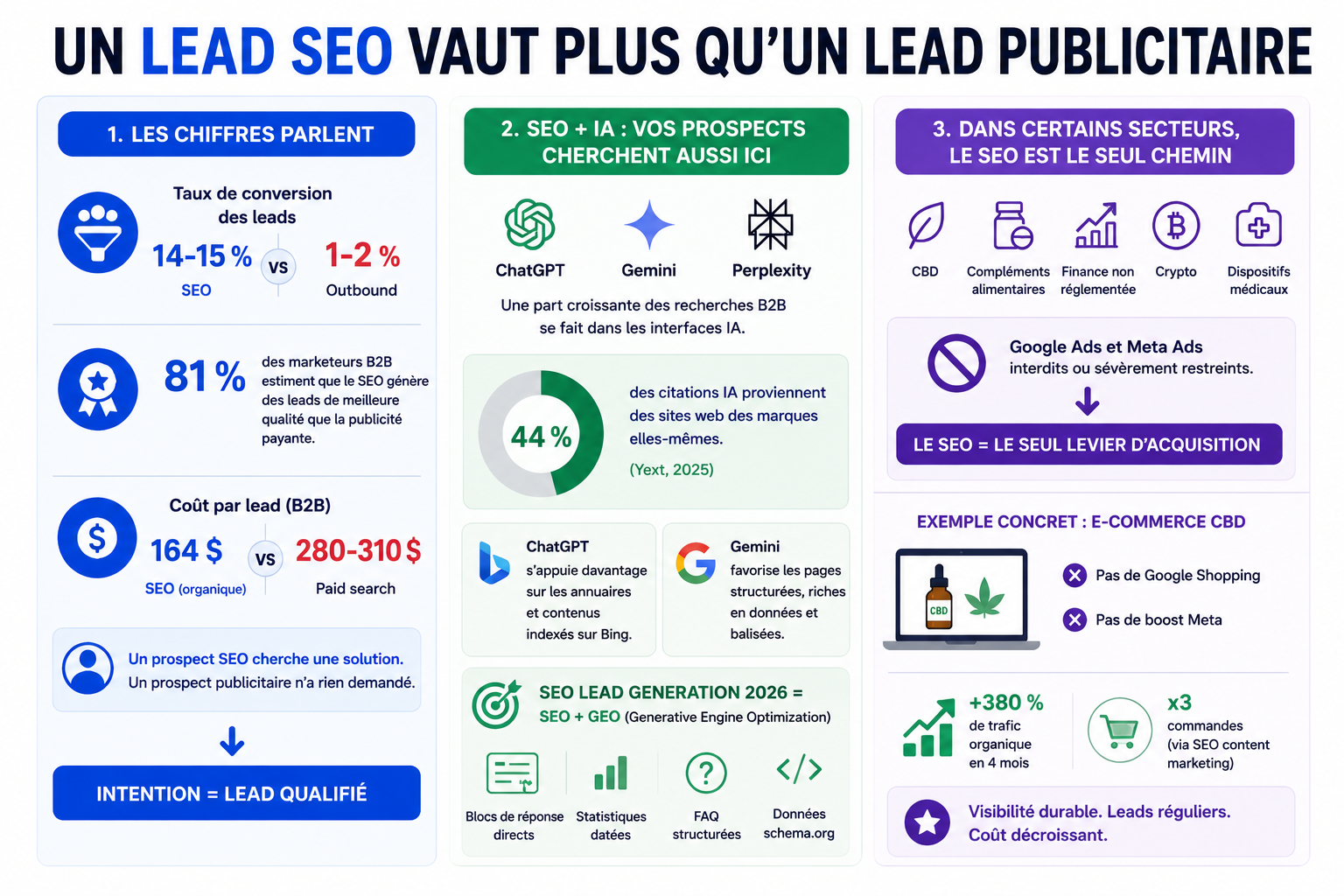
- An SEO lead converts to 14-15 % compared to 1-2 % for an outbound lead: the quality is not comparable.
- In 2026, generating leads through SEO is no longer limited to Google—ChatGPT and Gemini will reference your pages and send you prospects who are ready to buy.
- A structured approach to 90 days That's all it takes to start seeing the first qualified leads come in.
- For industries where Google Ads is prohibited (CBD, finance, healthcare, crypto), SEO isn't an option: it's the only channel.
Why SEO Is the Best Lead Generator (And Not Just for Google)
SEO is the only marketing strategy that works while you sleep. No advertising budget to replenish every Monday morning. No cost-per-click that skyrockets as soon as the competition heats up. Once it’s set up, the machine keeps running.
But in 2026, the real question is no longer «Does SEO generate leads?»—the answer is yes, in a big way. The real question is: Is your SEO set up to capture qualified leads, including those from AI-powered search engines?
An SEO lead is worth more than an advertising lead
The numbers speak for themselves. According to aggregated data from First Page Sage and HubSpot (2025–2026):
- SEO lead conversion rate: 14–15 % vs. 1-2, % for outbound.
- 81 % of B2B Marketers believe that SEO generates higher-quality leads than paid advertising.
- The cost per organic lead is around 164 $ in B2B, compared to 280–310 $ for paid search.
Why the difference? Because a prospect who types «business lawyer Paris» into Google has already identified their problem. They’re looking for a solution. They’re ready to take action. The prospect who sees a Facebook ad, on the other hand, hasn’t asked for anything.
That's what a qualified SEO lead : someone who approaches you with a specific intention.
SEO + AI: Your Prospects Are Also Searching on ChatGPT and Gemini
Here's what most traditional SEO agencies still don't realize: Your prospects aren't just searching on Google anymore.
In 2025–2026, an increasing share of B2B searches is conducted directly in ChatGPT, Gemini, or Perplexity. «Which SEO agency is best for an SME?» «What’s the best project management tool for a team of 10?» These questions end up in conversational interfaces—and those interfaces cite sources.
An analysis of 6.8 million AI citations (Yext, 2025) reveals that 44 %: Some of the quotes come from the brands' own websites. Gemini particularly favors structured pages that are rich in factual data and marked up with schemas. ChatGPT relies more on directories and content indexed on Bing.
The SEO Lead Generation In 2026, this means optimizing for Google AND for AI-powered search engines. This is called the GEO (Generative Engine Optimization). In practical terms: direct answer blocks at the beginning of the article, dated statistics, structured FAQs, and schema.org data. Exactly what you’re reading here.
SEO: The Only Viable Channel for Industries Where Advertising Is Prohibited
CBD, dietary supplements, unregulated finance, cryptocurrency, and certain medical devices: Google Ads and Meta Ads are prohibited or severely restricted in these sectors.
For these companies, SEO isn't just «one of many good ideas.» It's the only digital acquisition channel available.
A concrete example. A CBD e-commerce store cannot run a Google Shopping campaign. It cannot boost its Meta posts. As a result, it must either focus entirely on SEO or remain invisible. We helped this type of client grow from zero to over 380 % in organic traffic in 4 months, tripling their orders—solely through SEO content marketing.
The 4 Pillars of an SEO Strategy That Generates Leads
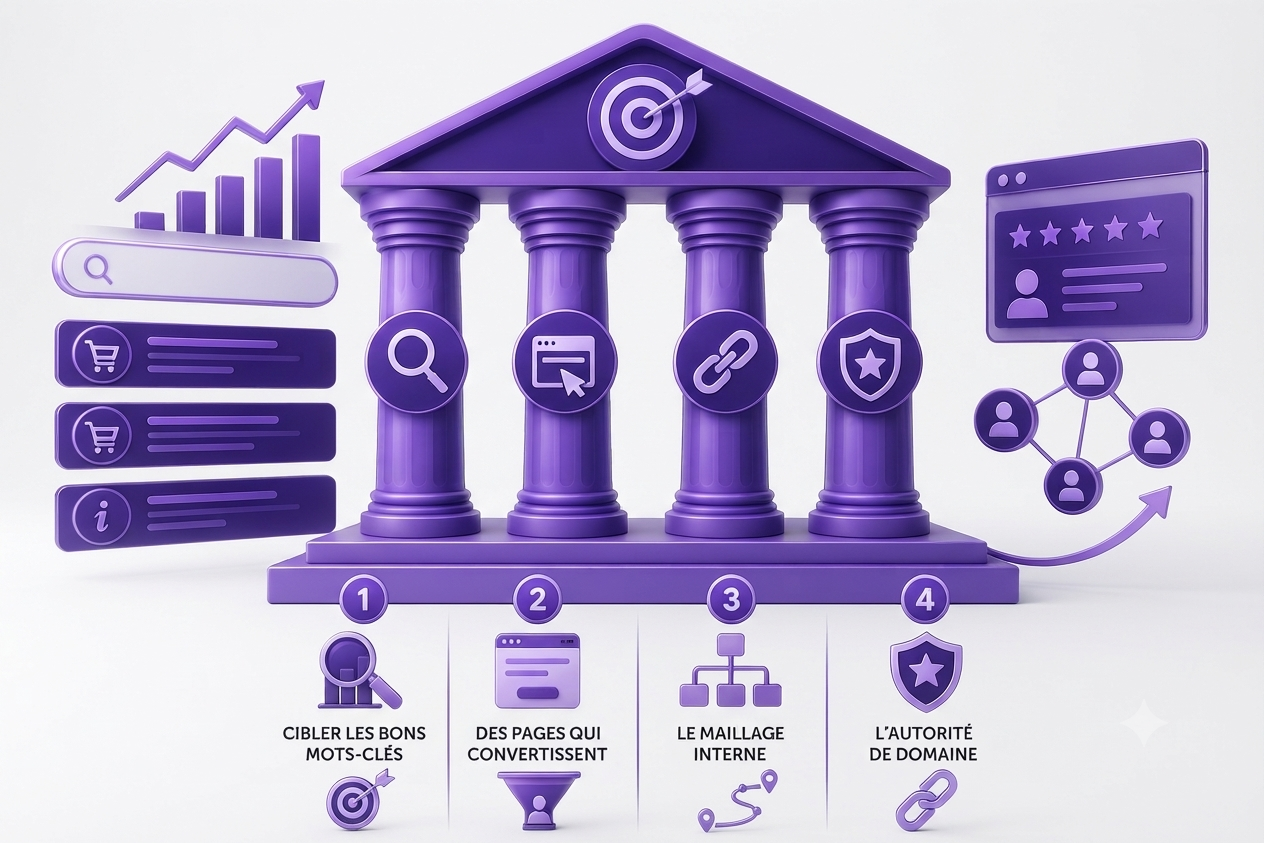
Many websites get traffic. Few generate leads. The difference comes down to four factors.
1. Target the right keywords (purchase intent, not just traffic)
The classic trap: optimizing for high-volume keywords that only attract casual visitors. «What is SEO?» generates traffic. «SEO lead generation agency in Paris» generates leads.
The golden rule: Prioritize keywords with commercial or transactional intent.
- «SME accounting firm in Lyon» → purchase intent
- «invoicing software for self-employed individuals» → transactional intent
- «How does VAT work?» → purely informational intent
Informational keywords have a place in a strategy for SEO Content Marketing – They help build brand awareness and authority. But they shouldn’t take up all your content budget if your goal is to generate leads right now.
2. Pages that convert, not just pages that rank
Ranking #1 on Google is good. But it's even better if the visitor fills out a form or calls.
What does a lead-generating page look like?
- A title that reflects the intent (not just the keyword)
- A clear value proposition within the first 5 seconds
- A CTA that's visible without scrolling (above the fold)
- Social Proof : customer reviews, statistics, logos
- A short form : first name, email, need—that's it
Most websites have pages that rank well but don't convert. It's like a beautiful store with no access road. Traffic comes in, leaves, and you never see it again.
3. Internal linking: the path that leads prospects to you
Internal linking is the system of links between your pages. It serves both as an SEO signal (Google understands your site’s structure) and as a conversion tool (you guide visitors to the next step).
A blog post on «how to choose a business lawyer» should link to your «Corporate Legal Advice» service page. That page should link to your contact form. It’s a funnel, not a dead end.
Rule of thumb : Each informational content page must contain at least one link to a commercial page.
4. Domain Authority: Why Google Trusts You (or Doesn't)
Domain Authority (or DR, depending on the tool) is a measure of the trust Google places in your site. It is primarily built through backlinks – inbound links from other websites.
The higher your authority, the easier it is for your pages to rank, even for competitive keywords.
How can we actually build it?
- Create content worth sharing (studies, original data, reference guides)
- Digital Media Relations : guest articles in media outlets in your industry
- Partnerships : relevant link exchanges with complementary partners
- Reference Directories : Yellow Pages, Trustpilot, industry directories
The 90-Day Method for Generating Your First SEO Leads
SEO takes time—but not as much as you might think if you follow a structured approach. Here’s the timeline we consistently follow.
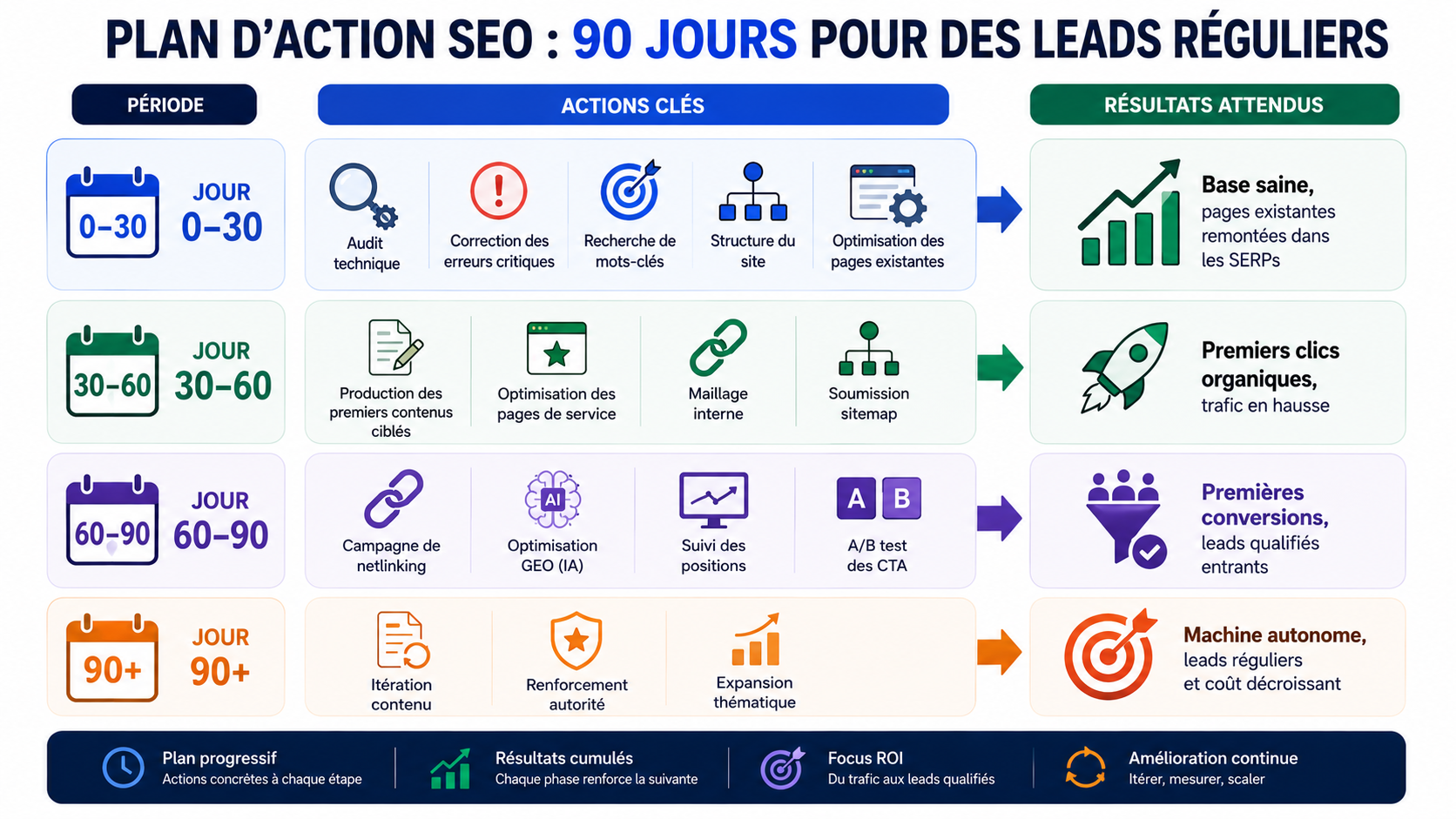
Days 0–30: Technical Foundations
Let's tackle the issues that yield quick results. A slow website (Core Web Vitals in the red), pages with duplicate content, a poorly configured sitemap: these technical issues hold everything else back.
Checklist Days 0–30:
- Comprehensive technical audit (Screaming Frog, Google Search Console)
- Fixing 404 errors and 301 redirects
- Speed Optimization (PageSpeed score > 80)
- Title and meta description tags on all key pages
- Keyword Research with Intent Mapping
Days 30–60: Content That Attracts and Converts
This is where B2B lead generation takes shape. We produce content targeted at the commercial-intent keywords identified in Month 1.
Priority formats:
- Optimized service pages (one page per service, per geographic area if applicable)
- Blog posts with a strong commercial focus («Best X for Y,» «How to Choose X»)
- Comparison pages («X vs. Y,» «alternatives to X»)
- Themed landing pages with a form
Each piece of content is structured for GEO: direct-answer blocks, statistics, and FAQs at the end of the article.
Days 60–90: Building Authority and Generating the First Qualified Leads
We enable netlinking and optimize the pages that are starting to rank but aren't converting yet.
This is also the stage at which you set up the dashboard for tracking SEO leads: Google Search Console for rankings, Google Analytics 4 for conversions, and tracking of form submissions by traffic source.
Typical result at Day 90: The first organic conversions are coming in. It's not a steady stream yet, but the signs are there.
Day 90+: The machine runs on its own
Starting at 3 months, SEO enters a phase of capitalization. Each new piece of content benefits from the authority that has been built up. Existing pages continue to climb in rankings. The cost per lead decreases month after month.
That's where SEO's ROI skyrockets: 825 % over 3 years On average, according to industry studies, compared to paid ROI, which stops as soon as you cut the budget.
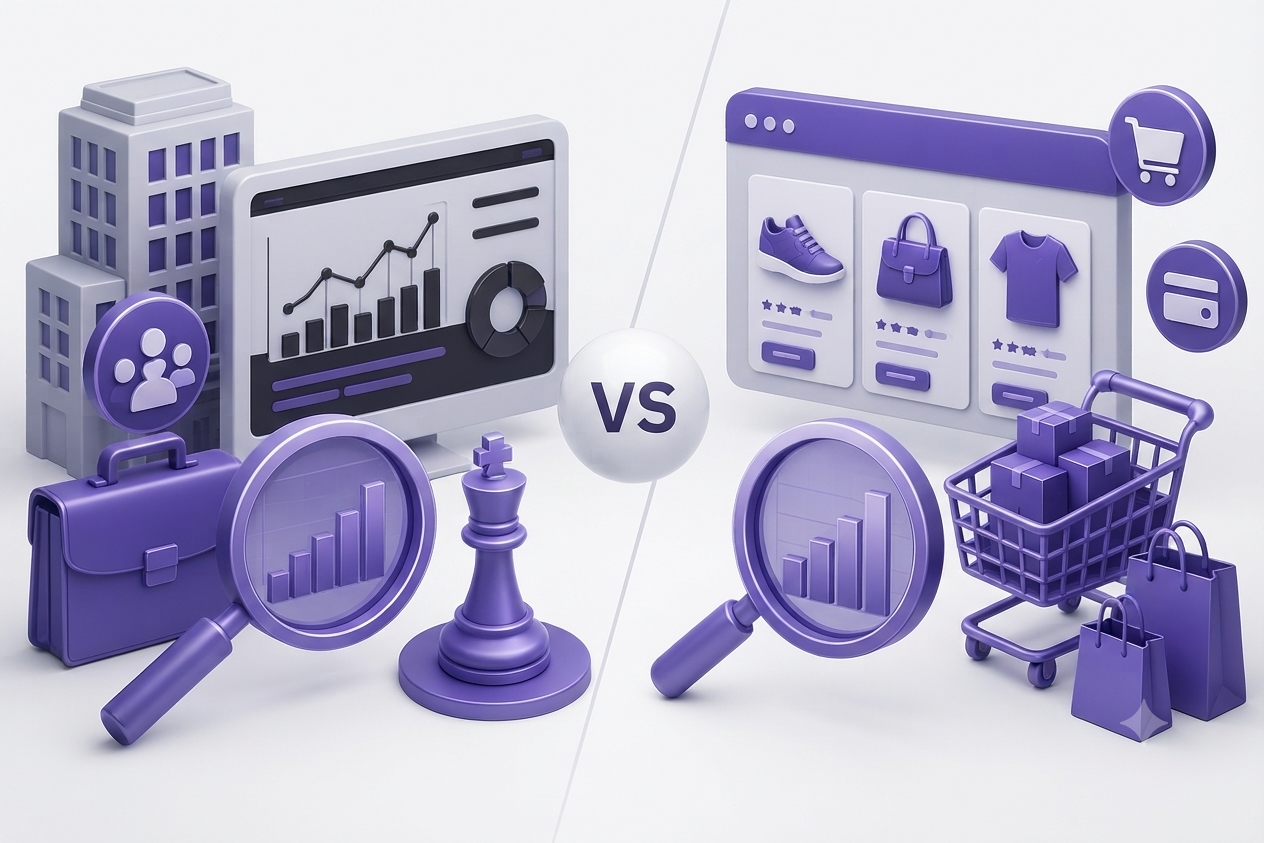
B2B SEO vs. E-commerce SEO: Two Approaches, Same Logic
Generating B2B Leads with SEO
In B2B, the sales cycle is long. Prospects spend weeks researching before contacting a service provider. Your SEO needs to be visible at every step of this journey.
Case Study – Law Firm, Paris. Starting from scratch (an existing but unoptimized website), we developed a strategy centered on three thematic clusters: corporate law, labor law, and commercial litigation. Results after 90 days: +340 % in organic traffic, increase from 0 to 8 qualified leads per month. The firm had invested in Google ads for two years without achieving comparable results.
Here are the specific B2B drivers:
- Highly specific service pages (by industry, by customer issue)
- Case studies and customer testimonials (social proof + search-engine-friendly content)
- Long-form educational content (guides, partially accessible white papers)
- Local SEO if you're targeting a specific geographic area
Case Study – Real Estate Developer, Lyon. A local SEO strategy focused on search terms such as «new construction in Lyon 3» or «rental investment in Lyon.» In 90 days: +12 qualified leads per month through local SEO, with a cost per lead that is 4 times lower than their previous Google Ads campaigns.
Generating E-commerce Sales with SEO
In e-commerce, the goal isn't a completed form but a placed order. The SEO strategy remains the same, but the target pages change.
Case Study – CBD E-commerce Store. Google Ads and Meta Ads are prohibited in this sector. SEO was the only strategy. We worked on product listings (optimizing titles, unique descriptions, Product Schema), categories (thematic pillar pages), and an informative blog to capture search queries early on. Results after 4 months: +380 % in organic traffic, ×3 on organic orders.
Here are the specific e-commerce strategies:
- Optimizing product pages (title, H1, unique description, schema)
- Category pages optimized as SEO landing pages
- Blog content targeting search queries such as «best X,» «X reviews,» and «X vs. Y»
- Internal linking between articles and product pages
In e-commerce, a well-structured SEO strategy transforms your product catalog into a true acquisition channel, capable of generating sustainable sales without relying on paid advertising.
How to Measure Your SEO Leads (The Right Dashboard)
Forget about rankings for the sake of rankings. What matters to an SME executive is the revenue generated through organic channels. Tracking your traffic isn't enough. To measure the true impact of SEO, focus on metrics that directly link your visibility to your leads and revenue.
| Metric | Tool | Why It Matters |
|---|---|---|
| Organic conversions (forms, calls, purchases) | GA4 + Search Console | This is the main KPI |
| Organic Traffic by Page | Google Search Console | Identify the pages that perform well |
| Conversion rate per page | GA4 | Identify the pages to optimize |
| Rankings for Target Keywords | Search Console / SEMrush | Measuring Progress |
| Revenue Attributed to Organic Channels | GA4 (e-commerce) | The only number that matters to executives |
| AI Quotes (ChatGPT, Gemini) | Manual tracking + GEO tools | The Metric of the Future |
A good SEO dashboard doesn't just track your Google rankings—it shows which content generates leads, sales, and a tangible return on investment.
What Your Competitors Are Missing (and What Makes the Difference)
Most of your competitors track their rankings. Some track their traffic. Very few track the SEO leads by content source – that is, which blog post or service page generated which lead.
Yet it is this data that allows us to make decisions: double down on content that converts, and stop producing content that only generates worthless traffic.
Recommended configuration in GA4:
- Conversion event on each form (by type: contact, quote, download)
- «Organic traffic» segment applied to all conversion reports
- «First-click» attribution report to identify the content that brings users into the funnel
And starting in 2025, add a column to your dashboard: Traffic coming from chatgpt.com and gemini.google.com. These sources are already trackable in GA4 via the acquisition reports. They will become increasingly important.
3 Mistakes That Are Killing Your SEO Lead Generation
You publish content, you get traffic… but the requests for quotes aren't coming in? In most cases, the problem isn't with Google, but with the strategy. Here are the The 3 Most Common Mistakes that prevent your SEO from generating qualified leads—and, most importantly, how to fix them quickly.
Mistake 1: Targeting traffic with no commercial intent
This is mistake number 1: publishing generic, informational articles just to «get traffic» without ever targeting keywords that indicate purchase intent. The result: thousands of visitors who read the content, leave, and never buy anything.
The correction: For each keyword you target, ask yourself: «Is someone who types that in likely to become a customer within 30 days?» If the answer is no, that content should be a secondary priority in your editorial plan.
Mistake 2: Optimizing for Google but Ignoring AI
In 2026, ignoring ChatGPT and Gemini in your SEO strategy is like ignoring mobile in 2015. It still seems optional—until the day you realize your competitors have been generating leads through these channels for the past 18 months.
The marketing leads Those who arrive via an AI referral are particularly qualified: the prospect asked a specific question to an AI assistant, which cited your site as a reference. The level of trust is at its highest.
The correction: Structure each piece of content with a direct answer block (40–60 words) at the beginning of the article, dated statistics, an FAQ section, and schema.org data. This is what triggers citations in AI search engines.
Mistake 3: Waiting 6 months without a clear plan
«SEO takes time» has become an excuse for not structuring the process. Yes, it takes a few weeks to see results. No, that doesn’t justify moving forward without clear milestones.
Without a structured approach—audit, keywords, content, backlinking, and measurement—you could go 12 months without seeing a single lead. With a 90-day plan, you’ll start seeing results as early as the second month.
The correction: Require your lead generation agency (or yourself) to provide an action plan with monthly deliverables, KPIs defined from day one, and a shared dashboard.
FAQ – SEO Lead Generation
How long does it take to generate leads with SEO?
The first signs of success (increased traffic, top rankings) generally appear within 4 to 8 weeks for low-competition keywords. The first qualified leads typically arrive between the 2nd and 3rd month when using a structured approach. For highly competitive keywords, expect it to take 4 to 6 months.
What is the difference between an SEO lead and an advertising lead?
An SEO lead comes from an active search: the prospect entered a specific query, which indicates a clear intent. An advertising lead is often intrusive—the ad appears without the person having expressed a need. That’s why SEO leads convert at a rate of 14–15 %, compared to 1–2 % for outbound marketing.
Does SEO work for small and medium-sized businesses with a limited budget?
Yes, and often better than for large companies. An SME can dominate local or niche keywords with a modest content budget, in areas where a large, general-interest brand will never be able to establish itself. The key is to target specific keywords with low competition but high purchase intent.
Do You Need a Blog to Generate Leads Through SEO?
Not necessarily. Well-optimized service pages may be sufficient for transactional keywords. A blog helps build authority more quickly and allows you to capture leads early in the buying cycle. For an SME, we recommend starting with service pages and then adding a blog starting in the second month.
How can you measure SEO ROI in euros, rather than in rankings?
Set up conversion events in GA4 (form submission, ad click, purchase) and filter by the «organic search» source. Assign an average value to each lead type (e.g., value of a client account = €2,000, closing rate = 30% → value of a lead = €600). Multiply by the number of monthly organic leads. You now have your SEO ROI in euros.
Can ChatGPT and Gemini really generate leads?
Yes, and this can already be measured today. In GA4, visits from chatgpt.com and gemini.google.com appear in the acquisition reports. Companies that are well-positioned in AI-powered search results are already seeing 5 to 15 % of their incoming traffic coming from these sources in 2025–2026. This figure will continue to grow.
What's the difference between SEO and SEA when it comes to generating leads?
SEA (Google Ads) generates leads immediately but stops as soon as you cut the budget. SEO generates leads over the long term, with a cost per lead that decreases over time. The two are complementary, but for an SME looking to reduce its reliance on advertising budgets, SEO is the top strategic investment.