Key points:
- Backlinks remain the No. 1 indicator of authority for Google in 2026—and they are playing an increasingly important role in the responses of AI systems such as ChatGPT and Gemini.
- Quality trumps quantity : A single editorial link from an industry-specific media outlet is worth a hundred links from low-quality directories.
- Backlink Strategy = Brand Strategy : Branded anchors help build your brand awareness just as much as your backlink profile.
- All it takes is 5 steps To structure your acquisition strategy: audit → competitor analysis → priority pages → tactics → measurement.
Why Backlinks Remain the Number One Pillar of Your Authority in 2026
We often hear that «backlinks are dead.» That’s not true.
PageRank – Google’s founding algorithm, patented in 1998 – is based on a simple idea: an inbound link is a vote of confidence. Twenty-eight years later, the logic still holds true. The pages ranked No. 1 on Google have, on average, 3.8 times more backlinks than those ranked in positions 2 through 10, according to the Backlinko study of 12 million search queries.
But by 2026, backlinks will do much more than just boost your rankings.
NavBoost amplifies the impact of your links
NavBoost is Google's system that weights behavioral signals—time spent on the page, long clicks, brand searches—in the ranking calculation. Here's the direct connection to your backlink strategy: an article that mentions you in Le Monde or BFM Business generates trademark searches («your company name + service»). These searches feed into NavBoost, which in turn strengthens your search rankings. It’s a virtuous cycle.
GEO: Your backlinks influence ChatGPT and Gemini
GEO (Generative Engine Optimization) refers to optimization for generative search engines. And backlinks play an underestimated role in this.
ChatGPT primarily cites sources found on Wikipedia, Forbes, major industry media outlets and key publications. Gemini, on the other hand, relies more on the entity signals – brand mentions, structured data, and consistency across the web ecosystem. In both cases, a strong backlink profile, rooted in reputable sources, significantly increases your chances of being cited.
Branded mentions have a correlation of r=0.664 with AI quotes, versus r=0.218 for raw backlinks. In other words: backlinks that build brand awareness are doubly valuable.
The 3 Types of Backlinks That Really Matter
Not all links are created equal. Here's how to rank them.
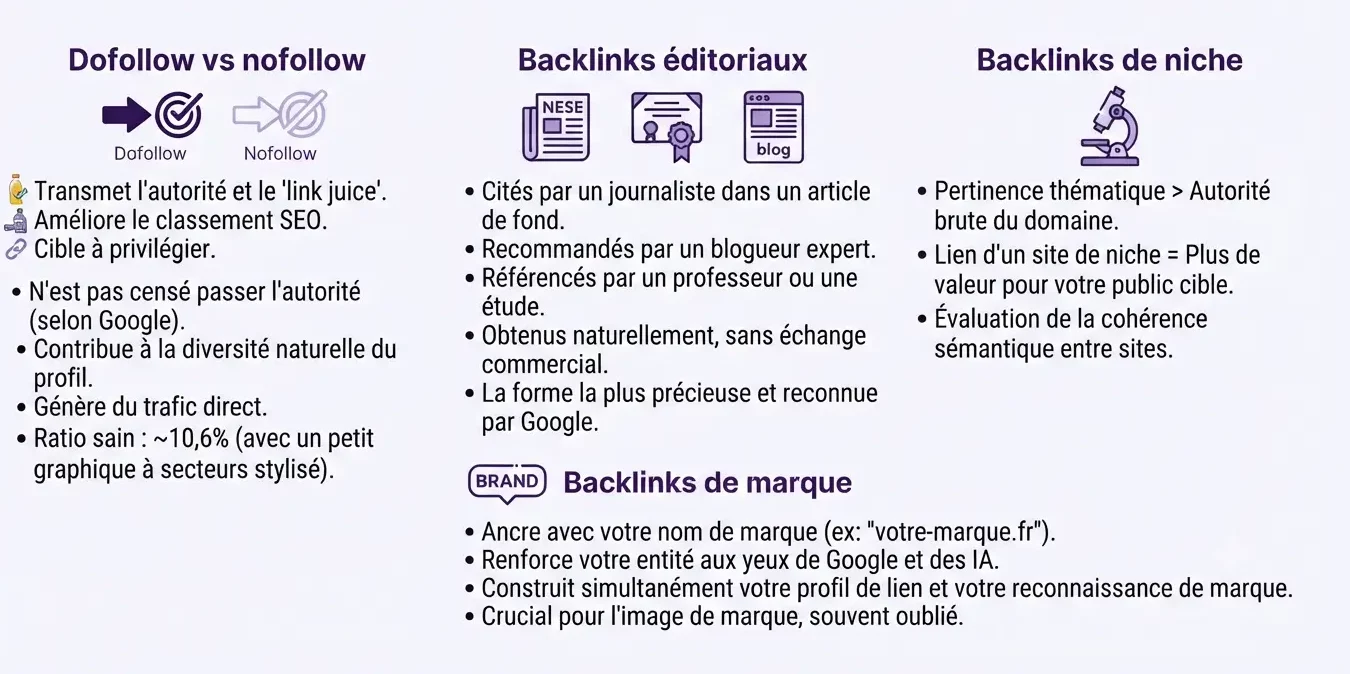
Dofollow vs. Nofollow
- Dofollow : passes «link juice» (authority) to the target page. This is the type of link you should prioritize.
- Nofollow : According to Google, it is not supposed to pass on authority. In practice, it contributes to the natural diversity of the profile and can generate direct traffic.
A healthy profile combines both. According to Ahrefs, 10.6 % backlinks About 110,000 of the most-visited sites use the "nofollow" attribute—a ratio to keep in mind as a benchmark.
Editorial Backlinks
These are the the best backlinks out there. A journalist quotes you in a feature article, an expert blogger recommends you in their guide, a college professor cites your study. These links are earned organically, without any commercial exchange—and Google knows it.
Niche Backlinks
The thematic relevance often outweighs the domain’s raw authority. A link from a blog specializing in e-commerce with a DR of 35 is often more valuable to an e-commerce site than a general-interest link from a site with a DR of 70. Google evaluates the semantic relevance between the source site, the source page, and the target page.
Brand Backlinks
The branded anchors («Rank-Up,» «your-brand.fr») simultaneously build your backlink profile and brand recognition. Every time your name appears as an anchor text on a third-party site, you strengthen your brand’s presence in the eyes of Google—and generative AI. This is the often-overlooked link between link building and brand image.
How to Evaluate the Quality of a Backlink
Before accepting or requesting a link, evaluate it based on these 5 criteria.
Domain Rating / Domain Authority
DR (Domain Rating, Ahrefs) and DA (Domain Authority, Moz) are scores ranging from 0 to 100 that estimate the strength of a domain's backlink profile. They are not not official Google ranking factors, but they correlate with actual performance. A DR > 50 is a good starting point for a high-quality backlink.
Thematic Relevance
This is the criterion that’s gaining importance. A link from a site in your industry—even one with a modest Domain Rating—will often be more beneficial than an off-topic link from a high-authority domain. Ask yourself, «Does this site resonate with my target audience?»
Variety of anchors
A natural anchor profile combines:
- Branded anchors : «Your Brand,» «yoursite.fr»
- Generic anchors : «Click here,» «Learn more»
- Partially Optimized Anchors : «SEO agency in Paris»
- Exact anchors : «backlink strategy» (to be used sparingly)
Too many identical exact matches = a sign of over-optimization = risk of a penalty.
Page Layout
A link in the body of the text (in-content) is worth much more than a link in the footer or sidebar. Google gives more weight to contextual links that are surrounded by semantically relevant text.
Red flags to avoid
- PBN (Private Blog Networks) : networks of websites created solely to sell links—SpamBrain is getting better and better at detecting them.
- Link farms : websites with no actual content, just lists of links.
- Total off-topic sites : A link from a casino website to your clothing store is of no benefit and could actually be harmful.
- Reactivated Expired Domains : This practice has been on Google's radar since the 2024 spam updates.
Build Your Backlink Strategy in 5 Steps
Let's get down to business. Here's the step-by-step method.
Step 1 – Audit Your Existing Backlink Profile
Before building, we assess the situation. Use Ahrefs, Semrush or Majestic to extract:
- The number of referring domains (unique referring domains)
- The distribution of anchors
- Toxic Links to Disavow via Google Search Console
Step 2 – Analyze Your Competitors' Backlinks (Gap Analysis)
Identify the 3 to 5 direct competitors that rank for your target keywords. Export their backlink profiles. Find the domains that link to them but not to you—that’s your priority prospecting list.
Step 3 – Identify the pages you want to link to first
Not all pages deserve the same amount of effort when it comes to link building. Prioritize:
- The Homepage for the global domain authority
- Service pages or categories for business inquiries
- Blog Posts with High Potential for informational requests
For an e-commerce site, category pages and featured product pages deserve special attention.
Step 4 – Choose Your Acquisition Tactics
See the next section. Each tactic has its own cost, duration, and effectiveness.
Step 5 – Measure and Iterate
The KPIs To be continued every month:
- Referring domains : an increase in the number of unique domains pointing to your site
- DR / DA Progression : Changes in Your Authority Score
- GSC Impressions : New backlinks should result in more impressions in Google Search Console
- Rankings for Target Keywords : the final indicator
8 Practical Tactics for Getting High-Quality Backlinks
Here is the arsenal. Choose your weapons based on your sector, budget, and resources.
1. Guest posting (guest article)
You write a high-quality article for a blog or media outlet in your industry in exchange for a link to your website. This is the most scalable tactic for small and medium-sized businesses. Target sites with a DR > 40 and a real audience—not «guest post farms.».
2. Digital PR / linkbait
Post a original study, an industry barometer, an infographic with exclusive data. Journalists and bloggers naturally cite their data sources. A well-structured study can generate dozens of editorial links in just a few weeks. It’s also the best strategy for getting cited by ChatGPT and Gemini.
3. Broken Link Building
Find broken links on websites in your industry (via Ahrefs > «Broken Links»). Offer your content as a replacement. Decent conversion rate, moderate effort.
4. Unlinked brand mentions
Is your brand mentioned online without a link? That's untapped gold. Use Google Alerts or Mention.com To identify them, contact the authors to have the mention converted into a link.
5. Customer Testimonials and Case Studies
Ask your suppliers or partners for a testimonial. Most of them post these testimonials on their websites with a link to the client. Simple, quick, effective—and often overlooked.
6. High-quality directories and listings
Not all directories, but the good ones: Chamber of Commerce and Industry, Yellow Pages, Kompass, Trustpilot, Google Business Profile. These structured citations also strengthen your presence in local search results and AI responses. For Free backlinking, it's the perfect starting point.
7. Partnerships and Co-Marketing
Publish joint content with a complementary (non-competing) partner. Each party links to the other. Both benefit from the other’s audience. This is twice as effective if the partner has a strong media presence.
8. Relinking (T2/T3)
The SEO relinking involves strengthening your existing backlinks by sending them second- or third-tier links. In practice: you get a link on an external blog post → you boost that post with additional links → the authority passed on to your site increases. An advanced technique detailed in our guide SEO relinking.
Backlinks and GEO: How to Get Mentioned by ChatGPT and Gemini
This is the next frontier in SEO. And your backlinks are already playing a role in it.
How AI Uses Backlinks as a Signal of Authority
ChatGPT and Gemini do not crawl the web in real time for every query. They rely on training data and, for versions with web access, from sources they consider reliable. The logic is similar to Google’s: a site cited by recognized sources is more likely to be considered authoritative.
94.7% of content cited by AI in Q1-Q3 are associated with external backlinks, according to Ahrefs data from 2025.
The sources that ChatGPT and Gemini prefer
Not all AI models rely on the same types of sources. Understanding which ones they favor allows you to tailor your content strategy and increase your chances of being cited in their responses.
| Source | ChatGPT | Gemini |
|---|---|---|
| Wikipedia | Very good | Strong |
| Major media outlets (Le Monde, BFM, etc.) | Very good | Strong |
| Industry Publications | Strong | Strong |
| Brand website | Moderate | Very good |
| Reference Directories | Moderate | Moderate |
To be visible in AI responses, you need to have a presence on recognized, credible, and authoritative sources. The more your brand is mentioned in this ecosystem, the more likely it is to be cited by ChatGPT or Gemini.
Practical Tactics for Generating AI Quotes
Being cited by AI isn't a matter of chance. Certain actions directly strengthen your brand's credibility and increase its chances of being included in responses from ChatGPT, Gemini, and other generative AI systems.
- Get quoted in the press : an article in Les Echos, BFM Business or a recognized industry publication is the strongest indicator of authority for AI systems.
- Check out Wikipedia : Contribute to existing articles with cited sources, or create a page if your company meets the notability criteria.
- Integrate the reference directories : Kompass, Societe.com, and other business directories in your industry.
- Publish original data : AI platforms cite industry studies and surveys—it’s both linkbait AND GEO at the same time.
AI citations are based first and foremost on trust and authority. By combining visibility in recognized sources, original data, and a presence in high-quality repositories, you can sustainably increase your chances of being cited by generative AI systems.
The «brand search loop»
Here is the complete virtuous cycle:
High-quality backlinks → Increased visibility → Brand searches → NavBoost → Better Google rankings → More natural backlinks → AI citations
That is exactly the combined approach SEO + AI-Powered GEO Optimization that we deploy for our clients.
Backlinks and Brand Image: The Often-Overlooked Connection
Most SEO teams treat backlinks as a technical tool. This is a misguided perspective.
Branded anchors build your brand awareness
Every time your name appears as an anchor text on a third-party website, you create a brand contact point. A reader who sees «Rank-Up» as a blue link in an article on Journal du Net They might not click on it—but they’ll have seen your name. Multiply that by hundreds of instances, and that’s brand awareness pure.
Press coverage = backlinks + brand authority
An article in a major media outlet provides you with the following all at once:
- A high-quality editorial backlink
- Social proof that your prospects can see
- A Strong Entity Signal for AI Engines
- Content you can share on your social media
That is why the Digital PR is the tactic with the highest ROI for small and medium-sized businesses that want to combine SEO, GEO, and brand image into a single initiative.
Being cited by ChatGPT = a sign of credibility for your prospects
In 2026, your prospects will use ChatGPT and Gemini to research products before making a purchase. If the AI directs them to you, it’s an implicit recommendation from a source perceived as neutral and authoritative. No advertising budget can buy that.
Turn Your Link Building into a PR Strategy
In practical terms: instead of «looking for backlinks,» think of it as «looking for visibility opportunities.» Every guest post is an in-depth article. Every published study is a press release. Every partnership is a joint announcement. This approach changes everything—and so do the results.
Our SEO agency systematically structures its backlink campaigns around this three-pronged approach: brand + authority + GEO.
Mistakes You Must Avoid at All Costs
An effective backlink strategy isn't just about getting backlinks—it's also about avoiding practices that can harm your SEO. Here are the most common mistakes to avoid in order to maintain your SEO authority over the long term.
Buying low-quality links
SpamBrain—Google's anti-spam AI—is continuously updated. Spam updates from March, June, and December 2024 have targeted networks of artificial links, revived expired domains, and mass-generated content. In 2026, buying links on low-quality platforms is like playing Russian roulette with your ranking.
Over-optimizing anchor text
Using «backlink strategy» as the exact anchor text for 80 % of your inbound links is an immediate red flag for Google. Diversify. Always.
Ignore thematic relevance
A link from a poker site to your accounting firm serves no purpose—and may indicate manipulation. Semantic consistency is non-negotiable.
Neglecting internal linking
Your inbound backlinks pass authority to the target page. But if that page isn't linked to the rest of your site by internal linking, the authority remains isolated. Every new page that receives backlinks must be incorporated into your internal architecture.
Focus on quantity rather than quality
Ahrefs confirms this: 66.5% of the links created over the past 9 years are now dead. Building quickly and poorly is like building on sand. Ten strong links from reputable publishers consistently outperform a hundred links from ghost sites.
When it comes to backlinks, quality, relevance, and naturalness always take precedence over volume. A sustainable strategy relies on trustworthy editorial links, integrated into a coherent SEO architecture designed to withstand changes in Google’s algorithms.
FAQ
How many backlinks do you need to rank well?
There is no one-size-fits-all number. It all depends on how competitive your industry is and the keywords you’re targeting. For a low-competition local search query, 10 to 20 high-quality referring domains may be enough. For a highly competitive national search query, you’ll need to build several hundred over time. The key metric isn’t the absolute number, but your relative position compared to competitors that are already growing.
What is the difference between netlinking and backlinking?
Both terms refer to the same thing. Backlinking is the generic English term used to refer to all incoming links pointing to a website. Netlinking is the term most commonly used in France to refer to the an active strategy for acquiring these links – the approach, tactics, and outreach. In practice, the two terms are used interchangeably in the French-speaking SEO community.
Do nofollow backlinks have any SEO value?
Officially, Google states that nofollow links do not pass PageRank. In practice, they contribute to the natural diversity of your backlink profile—a profile consisting entirely of 100 % dofollow links is itself suspicious. Furthermore, a nofollow link on a high-traffic site can generate direct traffic and brand mentions, which have their own indirect SEO value.
How long does it take for backlinks to have an effect?
Generally speaking, expect 4 to 12 weeks to see a measurable impact on your rankings, depending on your site’s crawl frequency and the strength of the referring domain. Links from frequently crawled sites (major media outlets, high-traffic sites) are indexed more quickly. The increase in DR, on the other hand, is measured by 3 to 6 months minimum.
How do backlinks affect my visibility on ChatGPT?
Indirectly, but effectively. Backlinks from reputable sources (the press, Wikipedia, authoritative directories) strengthen your entity authority – how AI systems perceive your brand as a reliable source. The more you’re cited by sources that ChatGPT and Gemini consider reliable, the more likely you are to appear in their responses. This is the essence of the GEO strategy: building a web presence that appeals to AI engines as much as it does to Google.